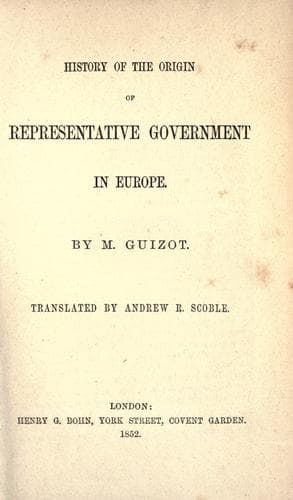
History of the Origin of Representative Government in EuropeGuizot, François
History
History of the Origin of Representative Government in Europe
Guizot, François
Europe -- History; Representative government and representation
It was not enough for John that he had entered into hostilities
with the lay aristocracy; he still further made himself inimical
to the clergy. On the death of the Archbishop of Canterbury, the
Augustin monks had arrogated to themselves the right of
appointing his successor without the consent of the king. John,
nettled by this invasion of his prerogatives, united with the
bishops, who also protested against an election in which they had
taken no part, and in concert with them, nominated the Bishop of
Norwich to the vacant see. Upon this, Innocent III. interfered in
the dispute;--but without confirming either of the two elections,
he ordered the English clergy to choose Cardinal Stephen Langton.
The king, enraged against the Court of Rome, drove all the monks
from Canterbury, and made himself master of their revenues.
Accordingly, the Pope excommunicated the monarch, placed the
whole kingdom under his ban, and released his subjects from the
oath of fidelity which they had sworn to John. Moreover, he
charged Philip Augustus to execute his decrees, and offered to
him the crown of England. Philip eagerly accepted the present,
while John, frightened by the double danger which pressed upon
him, demanded, but in vain, assistance from his barons;--he had
acted unjustly towards them, and now he found them indifferent to
his misfortunes. At last, stripped of all resources and left
without hope, he sought safety in submission, and saved himself
by means of base servility: he declared himself a vassal of the
pope, and engaged to pay him annually a tribute of a thousand
marks.
{311}
Commencement Of The Civil War.
After John had thus ransomed his crown, he soon endangered it
again by renewed acts of imprudence; his base tyranny, and his
criminal attempts on the wife of Eustace de Vesci, roused the
barons against him, and their opposition, was directed and
stimulated by the primate Langton.
It is not to be wondered at that the feudal aristocracy should
act under the guidance of an ecclesiastic; the two orders made
common cause, and this coalition, which preceding kings had
always endeavoured to prevent, was one of the effects of John's
odious and absurd conduct. He forgot that the royal power could
only maintain itself so long as the power of the clergy and that
of the barons balanced one another; when they united, he was
obliged to succumb. Their union was the result of John's base
submission to the Holy See; the English clergy, tired of the
despotism of Rome, and regretting the loss of their privileges,
openly embraced the cause of national liberty.
Public-domain text, read in full here on John Shaqi.
Reviews
Reviews
No reviews yet
Be the first to share your thoughts on this work.
Elsewhere in the archive
Join the Discussion
Join the discussion
Sign in to leave a comment or review.
Sign InorCreate an account