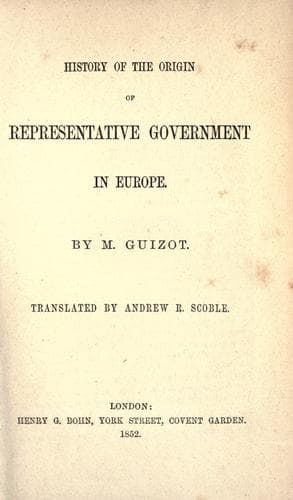
History of the Origin of Representative Government in EuropeGuizot, François
History
History of the Origin of Representative Government in Europe
Guizot, François
Europe -- History; Representative government and representation
"Art. 12. That no escuage or extraordinary aid shall be imposed
in our kingdom, except by the national council of our kingdom,
unless it be to ransom our person, to equip our eldest son as a
knight, and to marry our eldest daughter: and for these last
cases only a reasonable amount of aid shall be demanded, &c."
"Art. 14. In order to hold the national council of the kingdom,
for the purpose of imposing any other aid than for the three
cases heretofore mentioned, or to impose an escuage, we will
call together the archbishops, bishops, abbots, earls and great
barons, individually and by letters from ourself; and we will
assemble together by means of our viscounts and bailiffs, all
those who are directly dependent upon us.
{314}
The great convocation shall be made on a fixed day, namely, at
intervals not greater than forty days, and in an appointed
place; and in the letters of convocation we will expound the
reason of such convocation; and the convocation thus made, the
business shall be transacted on the day appointed, by the
council consisting of those who are present, although all those
who have been summoned may not have arrived."
This charter is the first document in which we find a distinction
established between the greater and lesser barons, and the higher
and lower clergy; an important fact, since it may perhaps be
regarded as the original source of the separation between the two
Houses of Parliament.
Lastly, several articles have for their object to limit the
rights of the king on the lands of his tenants, to fix the amount
of fine imposed on beneficiaries according to the gravity of
their offence, to determine the length of time during which lands
should remain sequestrated on account of felony; in one word, to
give to the barons greater independence and security than they
had ever before enjoyed.
These are the principal enactments of the Great Charter in favour
of the nobility; up to this point, we find only sanctions given
to particular privileges, we have only met with that which
favours the interests of certain classes in society. But it
contains also clauses of wider and more general application; it
has for its object also the interests of the nation as a whole.
First of all, almost all the immunities granted to the barons
with respect to the king, the vassals obtained with respect to
their lords. These were not allowed from this time to collect
aids and escuages on their lands, except in the same cases and in
the same manner as the king. (Art. 15.)
Justice was for the future to be administered in a fixed and
uniform manner; the following are the articles in which this
important provision is expressed:--
"Art. 17. The court of common pleas shall not follow our court
(_curia_), but shall be held in a fixed place.
Public-domain text, read in full here on John Shaqi.
Reviews
Reviews
No reviews yet
Be the first to share your thoughts on this work.
Elsewhere in the archive
Join the Discussion
Join the discussion
Sign in to leave a comment or review.
Sign InorCreate an account