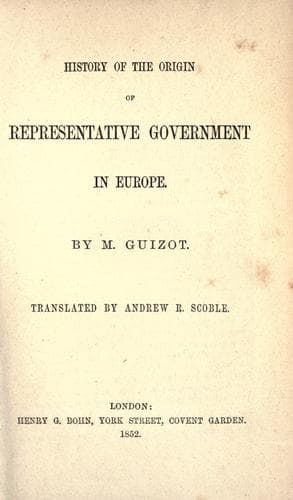
History of the Origin of Representative Government in EuropeGuizot, François
History
History of the Origin of Representative Government in Europe
Guizot, François
Europe -- History; Representative government and representation
War was declared: in vain did the Pope address letters to the
barons, in which he commanded them to desist from their
enterprise; the hostilities which had been commenced only
continued with greater vigour, and on the 24th of May, the
triumphant barons took possession of London with the consent of
the citizens. John left the city and retired to Odiham, in the
county of Hampshire, with no other escort than seven knights.
From his retreat he attempted, without success, to enter into
negotiations; he proposed the intervention of the Pope, but this
was also refused: baffled in all his attempts, he was at length
necessitated to acquiesce in the law which had been forcibly
imposed on him.
Conference At Runnymead.
On the 13th of June, a conference was opened in the plain called
Runnymead, between Windsor and Staines. The two parties had
separate encampments, as declared enemies; after some trifling
debates, the king at first adopted the preliminary articles, and
four days after, on the 19th of June, 1215, he made the grant of
the famous act known by the name of the Great Charter,--Magna
Charta.
{313}
Analysis Of Magna Charta.
This charter, the most complete and important that had yet
appeared, may be divided into three distinct parts; one referring
to the interests of the clergy, another regulating those of the
nobility, and the third, those belonging to the people. This
methodical division is not taken from the order in which the
articles of the actual charter are distributed, but I have here
adopted it in order to render my account of it more natural and
distinct.
The Great Charter refers but little to ecclesiastical interests,
since they had been settled by the charter already granted to the
clergy. All that was therefore required was that this should be
confirmed. This accordingly is done in the first article, which
grants a general confirmation to all ecclesiastical immunities
and privileges.
The privileges of the laity, on the other hand, were more
uncertain, and more strongly contested; it was therefore
necessary that they should be minutely investigated and
separately conceded. The Great Charter is almost entirely devoted
to the settlement of the rights, and the confirmation of the
privileges, claimed by the laity.
In the first place, it determines with precision what had been
obscure and ambiguous in the feudal laws; and it fixes the amount
of relief which the immediate or indirect inheritors of fiefs
should pay. Hitherto this relief had been indeterminate. (Arts. 2
to 3.)
Then follow the precautions prescribed respecting the marriage of
feudal wards, and those which regard the widows and children of
vassals. (Arts. 6 to 8.)
The right and mode of collecting aids and escuages, are regulated
by the two following articles:--
Public-domain text, read in full here on John Shaqi.
Reviews
Reviews
No reviews yet
Be the first to share your thoughts on this work.
Elsewhere in the archive
Join the Discussion
Join the discussion
Sign in to leave a comment or review.
Sign InorCreate an account