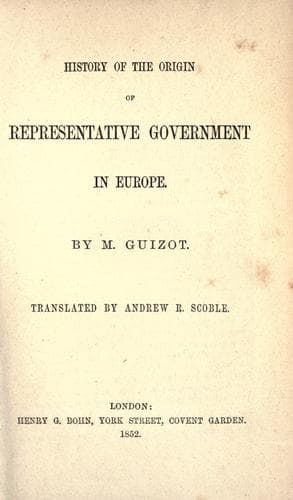
History of the Origin of Representative Government in EuropeGuizot, François
History
History of the Origin of Representative Government in Europe
Guizot, François
Europe -- History; Representative government and representation
Henry, who was but a child when his father died, found an able
protector in William, Earl of Pembroke, Marshal of England, who
was then commander of the royal armies. Pembroke had been a
faithful servant to King John, and transferred to the son that
friendship which he had given to the father. His only thought was
that Henry should succeed to the throne, and accordingly the
ceremony of coronation was performed at Gloucester, on the 28th
of October, 1216. Afterwards, in a council of barons assembled at
Bristol, on the 11th of November, he assumed the title of Regent,
and in order to render the cause of the young king popular he
granted a new charter in his--the king's--name. This charter
corresponded, with the exception of a few modifications, to that
given by King John. All the articles are omitted which refer to
the establishment of _escuages_, to the liberty of entering
and leaving the kingdom, to the preservation of forests and
dykes, and to the customs of the counties; moreover, the article
was suppressed which granted the right of resistance by armed
force in case the king should violate his promises. These
suppressions were not, however, definitely concluded; it is
stated in the charter that "the prelates and lords have
determined that these things shall remain open, until they have
more fully deliberated concerning them." [Footnote 20]
[Footnote 20: The original of this charter still exists in
the archives of Durham Cathedral.]
We see by this that the barons at that time showed themselves
less exacting than they had been during John's reign, or rather
that they no longer stipulated for any other interests than those
which personally affected themselves, neglecting those belonging
to other classes in the nation.
However this may be, this new charter produced the effect which
Pembroke had desired; it finally broke up the party which had
been formed in favour of Prince Louis of France, and strengthened
that of King Henry. The French, however, had still some adherents
left; the city of London especially persisted, with an obstinate
determination, in remaining faithful to them. But after numerous
reverses, they could hold out no longer; a treaty was concluded
between the two monarchs on the 11th of September, 1217; Louis
abandoned all pretensions to the crown, left England with the
remnant of his party, and Henry remained in quiet possession of
the sovereignty.
{321}
Public-domain text, read in full here on John Shaqi.
Reviews
Reviews
No reviews yet
Be the first to share your thoughts on this work.
Elsewhere in the archive
Join the Discussion
Join the discussion
Sign in to leave a comment or review.
Sign InorCreate an account