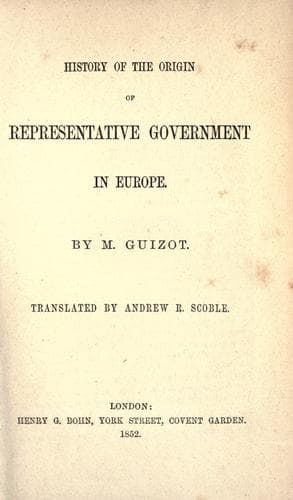
History of the Origin of Representative Government in EuropeGuizot, François
History
History of the Origin of Representative Government in Europe
Guizot, François
Europe -- History; Representative government and representation
The retreat of the French re-established harmony in the kingdom,
but in order to render the concord more certain and immediate two
more charters were granted. One was similar to the preceding;
only one remarkable modification is to be found, namely the
decision that the escuage should be levied as in the time of
Henry II. The other is known under the name of the Charta de
Forestâ, being the same that has been erroneously attributed to
King John: it has only one special aim, and contains nothing but
a series of regulations as to the extent and limits of the
forests belonging either to the nobility or to the crown.
Violation Of The Charters.
These charters were perpetually violated by the agents of power.
For several years these infractions did not occasion more than
partial complaints, but at length, in the year 1223, the
protestation became general and urgent. The council of barons was
summoned to London, where they demanded a new confirmation of the
charters. One of the councillors of the regency, William de
Briwere, ventured to oppose, saying that "all these liberties had
been extorted from the king;" but the Archbishop of Canterbury
smartly reproved him, telling him that if he loved the king, he
at all events would not venture to trouble the kingdom. The young
king promised that the charters should be henceforth observed,
and twelve knights were appointed in each county, who should
enquire what were, according to ancient usages, the rights of the
king and the liberties of his subjects.
Still, new anxieties soon excited new protestations. Since the
preceding reign the barons had held in trust most of the royal
castles and domains, and this was the principal guarantee they
had that their treaties should be observed. Suddenly their
possession of this guarantee was threatened: a bull of Pope
Honorius III., which declared Henry to be of age when he was
seventeen years old, ordered at the same time that all those who
had royal domains in their hands should restore them to the king.
This bull occasioned many suspicions as to Henry's intentions;
fears began to be entertained lest, having obtained his majority,
he should revoke the two charters to which he had sworn during
his minority. The king and his advisers perceived the necessity
of meeting this disturbed state of feeling, and on the 11th of
February, 1225, the king granted of his own accord a new
confirmation of the charters. As an acknowledgment of this they
granted him a fifteenth part of all the moveable property of the
kingdom as a subsidy.
{322}
Revocation Of The Charters.
But this mutual accommodation did not last long. At the end of
two years, Henry, having obtained his true majority, revoked all
the charters, under the pretext that they had been granted when
he was not in the free possession of his body and of his seal;
"_cum nee sui corporis nee sigilli aliquam potestatem
habuerit_."
Public-domain text, read in full here on John Shaqi.
Reviews
Reviews
No reviews yet
Be the first to share your thoughts on this work.
Elsewhere in the archive
Join the Discussion
Join the discussion
Sign in to leave a comment or review.
Sign InorCreate an account