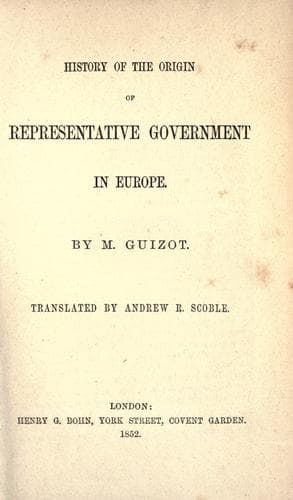
History of the Origin of Representative Government in EuropeGuizot, François
History
History of the Origin of Representative Government in Europe
Guizot, François
Europe -- History; Representative government and representation
This revocation excited the most active discontent. The indignant
barons turned their rage against the man whom the public voice
accused as the author of these proceedings. This was Hubert de
Burgh, the grand justiciary and intimate counsellor of Henry.
This minister was from that time exposed to the most violent
attacks, and did not cease to be persecuted by the rage of his
opponents till at length, in 1232, the king yielded to the storm,
withdrew his favour from the obnoxious minister, and exiled him
from the court.
The murmurs of the barons were hardly appeased when Henry seemed
as if desirous of exciting them afresh, by again surrounding
himself with men who were hated by his subjects. This was a
foreigner, a Poitevin, Peter des Roches, Bishop of Winchester,
who became the king's favourite on the disgrace of Hubert de
Burgh. From that time, only foreigners were trusted with places
and favours by the prince. Not content with draining the coffers
of the State, they burdened the people with exactions,--their
insolence was perfectly unbridled. When the laws of England were
appealed to against them, "we are not English," they said, "we do
not know what is the purport of these laws." The indignant barons
urgently demanded justice, and in the year 1234, two years after
the disgrace of Hubert de Burgh, the king found himself compelled
to abandon Peter des Roches and to dismiss the foreigners from
his court. But shortly after, on his marriage with Eleanor,
daughter of the Count of Provence, the Provençals took the place
of the Poitevins, and in their turn drew on themselves the hatred
of the English barons.
{323}
Conformation Of The Charters.
The irritation was general, when the king, who was in want of
money, assembled the barons at Westminster, in the month of
January, 1237, in order to demand of them a subsidy. The barons
answered him with a refusal and with menaces. Henry, alarmed at
this, had recourse to a remedy which had not yet lost its
efficiency, namely, a new confirmation of the charters. Hardly
was it granted before he obtained a subsidy of a thirtieth part
of all moveable property.
But his prodigality soon dissipated these feeble resources; again
was he obliged to resort to arbitrary and tyrannical means in
order to provide himself with money,--to exactions, to forced
loans, a new kind of impost which is then for the first time to
be met with in English history. It is remarkable, however, that
Henry never dared to levy any general tribute on the nation on
his own personal responsibility. Imposts that were really public
were never collected except under the professed sanction of a
council of the barons, and after the king had purchased their
good will by a new confirmation of the charters.
Public-domain text, read in full here on John Shaqi.
Reviews
Reviews
No reviews yet
Be the first to share your thoughts on this work.
Elsewhere in the archive
Join the Discussion
Join the discussion
Sign in to leave a comment or review.
Sign InorCreate an account