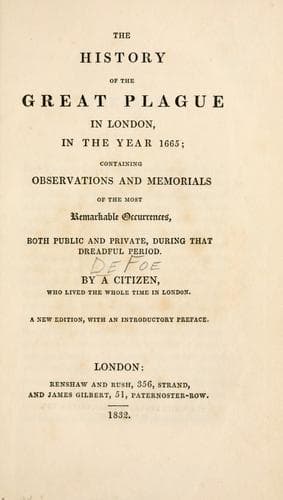
Historical fiction; London (England) -- History -- 17th century -- Fiction; Plague -- Fiction
At last they found means to carry their corn to a windmill near
Woodford, where they had it ground; and afterwards the biscuit baker
made a hearth so hollow and dry, that he could bake biscuit cakes
tolerably well, and thus they came into a condition to live without any
assistance or supplies from the towns. And it was well they did; for the
country was soon after fully infected, and about a hundred and twenty
were said to have died of the distemper in the villages near them, which
was a terrible thing to them.
On this they called a new council, and now the towns had no need to be
afraid they should settle near them; but, on the contrary, several
families of the poorer sort of the inhabitants quitted their houses, and
built huts in the forest, after the same manner as they had done. But it
was observed that several of these poor people that had so removed had
the sickness even in their huts or booths, the reason of which was
plain: namely, not because they removed into the air, but[209] because
they did not remove time[210] enough, that is to say, not till, by
openly conversing with other people, their neighbors, they had the
distemper upon them (or, as may be said, among them), and so carried it
about with them whither they went; or (2) because they were not careful
enough, after they were safely removed out of the towns, not to come in
again and mingle with the diseased people.
But be it which of these it will, when our travelers began to perceive
that the plague was not only in the towns, but even in the tents and
huts on the forest near them, they began then not only to be afraid, but
to think of decamping and removing; for, had they staid, they would have
been in manifest danger of their lives.
It is not to be wondered that they were greatly afflicted at being
obliged to quit the place where they had been so kindly received, and
where they had been treated with so much humanity and charity; but
necessity, and the hazard of life which they came out so far to
preserve, prevailed with them, and they saw no remedy. John, however,
thought of a remedy for their present misfortune; namely, that he would
first acquaint that gentleman who was their principal benefactor with
the distress they were in, and to[211] crave his assistance and advice.
This good charitable gentleman encouraged them to quit the place, for
fear they should be cut off from any retreat at all by the violence of
the distemper; but whither they should go, that he found very hard to
direct them to. At last John asked of him, whether he, being a justice
of the peace, would give them certificates of health to other justices
who[212] they might come before, that so, whatever might be their lot,
they might not be repulsed, now they had been also so long from London.
This his worship immediately granted, and gave them proper letters of
health; and from thence they were at liberty to travel whither they
pleased.
Public-domain text, read in full here on John Shaqi.
Reviews
Reviews
No reviews yet
Be the first to share your thoughts on this work.
Elsewhere in the archive
Join the Discussion
Join the discussion
Sign in to leave a comment or review.
Sign InorCreate an account