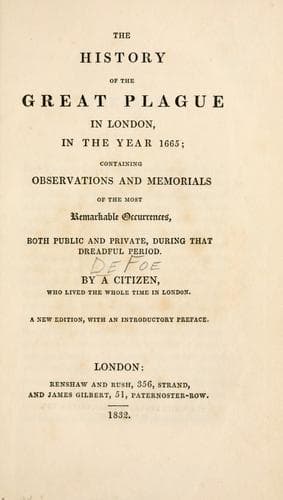
Historical fiction; London (England) -- History -- 17th century -- Fiction; Plague -- Fiction
There was one unhappy citizen, within my knowledge, who had been visited
in a dreadful manner, so that his wife and all his children were dead,
and himself and two servants only left, with an elderly woman, a near
relation, who had nursed those that were dead as well as she could. This
disconsolate man goes to a village near the town, though not within the
bills of mortality, and, finding an empty house there, inquires out the
owner, and took the house. After a few days he got a cart, and loaded it
with goods, and carries them down to the house. The people of the
village opposed his driving the cart along, but, with some arguings and
some force, the men that drove the cart along got through the street up
to the door of the house. There the constable resisted them again, and
would not let them be brought in. The man caused the goods to be
unloaded and laid at the door, and sent the cart away, upon which they
carried the man before a justice of peace; that is to say, they
commanded him to go, which he did. The justice ordered him to cause the
cart to fetch away the goods again, which he refused to do; upon which
the justice ordered the constable to pursue the carters and fetch them
back, and make them reload the goods and carry them away, or to set
them in the stocks[224] till they[225] came for further orders; and if
they could not find them,[226] and the man would not consent to take
them[227] away, they[225] should cause them[227] to be drawn with hooks
from the house door, and burned in the street. The poor distressed man,
upon this, fetched the goods again, but with grievous cries and
lamentations at the hardship of his case. But there was no remedy:
self-preservation obliged the people to those severities which they
would not otherwise have been concerned in. Whether this poor man lived
or died, I cannot tell, but it was reported that he had the plague upon
him at that time, and perhaps the people might report that to justify
their usage of him; but it was not unlikely that either he or his goods,
or both, were dangerous, when his whole family had been dead of the
distemper so little a while before.
I know that the inhabitants of the towns adjacent to London were much
blamed for cruelty to the poor people that ran from the contagion in
their distress, and many very severe things were done, as may be seen
from what has been said; but I cannot but say also, that where there was
room for charity and assistance to the people, without apparent danger
to themselves, they were willing enough to help and relieve them. But as
every town were indeed judges in their own case, so the poor people who
ran abroad in their extremities were often ill used, and driven back
again into the town; and this caused infinite exclamations and outcries
against the country towns, and made the clamor very popular.
Public-domain text, read in full here on John Shaqi.
Reviews
Reviews
No reviews yet
Be the first to share your thoughts on this work.
Elsewhere in the archive
Join the Discussion
Join the discussion
Sign in to leave a comment or review.
Sign InorCreate an account