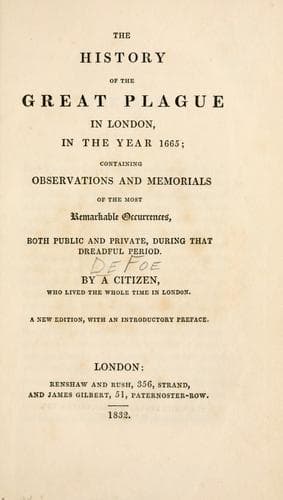
Historical fiction; London (England) -- History -- 17th century -- Fiction; Plague -- Fiction
And yet more or less, maugre[228] all the caution, there was not a town
of any note within ten (or, I believe, twenty) miles of the city, but
what was more or less infected, and had some[229] died among them. I
have heard the accounts of several, such as they were reckoned up, as
follows:--
Enfield 32
Hornsey 58
Newington 17
Tottenham 42
Edmonton 19
Barnet and Hadley 43
St. Albans 121
Watford 45
Uxbridge 117
Hertford 90
Ware 160
Hodsdon 30
Waltham Abbey 23
Epping 26
Deptford 623
Greenwich 631
Eltham and Lusum 85
Croydon 61
Brentwood 70
Rumford 109
Barking about 200
Brandford 432
Kingston 122
Staines 82
Chertsey 18
Windsor 103
_cum aliis._[230]
Another thing might render the country more strict with respect to the
citizens, and especially with respect to the poor, and this was what I
hinted at before; namely, that there was a seeming propensity, or a
wicked inclination, in those that were infected, to infect others.
There have been great debates among our physicians as to the reason of
this. Some will have it to be in the nature of the disease, and that it
impresses every one that is seized upon by it with a kind of rage and a
hatred against their own kind, as if there were a malignity, not only in
the distemper to communicate itself, but in the very nature of man,
prompting him with evil will, or an evil eye, that as they say in the
case of a mad dog, who, though the gentlest creature before of any of
his kind, yet then will fly upon and bite any one that comes next him,
and those as soon as any, who have been most observed[231] by him
before.
Others placed it to the account of the corruption of human nature,
who[232] cannot bear to see itself more miserable than others of its own
species, and has a kind of involuntary wish that all men were as unhappy
or in as bad a condition as itself.
Others say it was only a kind of desperation, not knowing or regarding
what they did, and consequently unconcerned at the danger or safety, not
only of anybody near them, but even of themselves also. And indeed, when
men are once come to a condition to abandon themselves, and be
unconcerned for the safety or at the danger of themselves, it cannot be
so much wondered that they should be careless of the safety of other
people.
Public-domain text, read in full here on John Shaqi.
Reviews
Reviews
No reviews yet
Be the first to share your thoughts on this work.
Elsewhere in the archive
Join the Discussion
Join the discussion
Sign in to leave a comment or review.
Sign InorCreate an account