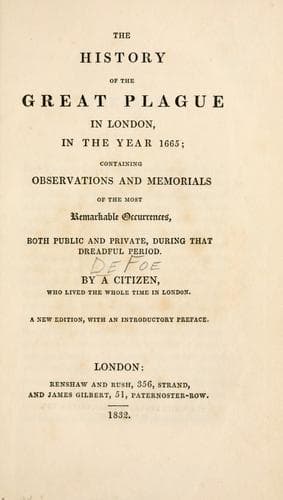
Historical fiction; London (England) -- History -- 17th century -- Fiction; Plague -- Fiction
This was a prodigious number of itself; but if I should add the reasons
which I have to believe that this account was deficient, and how
deficient it was, you would with me make no scruple to believe that
there died above ten thousand a week for all those weeks, one week with
another, and a proportion for several weeks, both before and after. The
confusion among the people, especially within the city, at that time was
inexpressible. The terror was so great at last, that the courage of the
people appointed to carry away the dead began to fail them; nay, several
of them died, although they had the distemper before, and were
recovered; and some of them dropped down when they have been carrying
the bodies even at the pitside, and just ready to throw them in. And
this confusion was greater in the city, because they had flattered
themselves with hopes of escaping, and thought the bitterness of death
was past. One cart, they told us, going up Shoreditch, was forsaken by
the drivers, or, being left to one man to drive, he died in the street;
and the horses, going on, overthrew the cart, and left the bodies, some
thrown here, some there, in a dismal manner. Another cart was, it seems,
found in the great pit in Finsbury Fields, the driver being dead, or
having been gone and abandoned it; and the horses running too near it,
the cart fell in, and drew the horses in also. It was suggested that the
driver was thrown in with it, and that the cart fell upon him, by reason
his whip was seen to be in the pit among the bodies; but that, I
suppose, could not be certain.
In our parish of Aldgate the dead carts were several times, as I have
heard, found standing at the churchyard gate full of dead bodies, but
neither bellman, or driver, or any one else, with it. Neither in these
or many other cases did they know what bodies they had in their cart,
for sometimes they were let down with ropes out of balconies and out of
windows, and sometimes the bearers brought them to the cart, sometimes
other people; nor, as the men themselves said, did they trouble
themselves to keep any account of the numbers.
The vigilance of the magistrate was now put to the utmost trial, and, it
must be confessed, can never be enough acknowledged on this occasion;
also, whatever expense or trouble they were at, two things were never
neglected in the city or suburbs either:--
1. Provisions were always to be had in full plenty, and the price not
much raised neither, hardly worth speaking.
2. No dead bodies lay unburied or uncovered; and if any one walked from
one end of the city to another, no funeral, or sign of it, was to be
seen in the daytime, except a little, as I have said, in the first three
weeks in September.
Public-domain text, read in full here on John Shaqi.
Reviews
Reviews
No reviews yet
Be the first to share your thoughts on this work.
Elsewhere in the archive
Join the Discussion
Join the discussion
Sign in to leave a comment or review.
Sign InorCreate an account