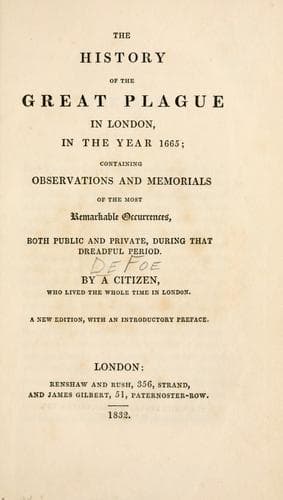
Historical fiction; London (England) -- History -- 17th century -- Fiction; Plague -- Fiction
This last article, perhaps, will hardly be believed when some accounts
which others have published since that shall be seen, wherein they say
that the dead lay unburied, which I am sure was utterly false; at least,
if it had been anywhere so, it must have been in houses where the living
were gone from the dead, having found means, as I have observed, to
escape, and where no notice was given to the officers. All which amounts
to nothing at all in the case in hand; for this I am positive in, having
myself been employed a little in the direction of that part of the
parish in which I lived, and where as great a desolation was made, in
proportion to the number of the inhabitants, as was anywhere. I say, I
am sure that there were no dead bodies remained unburied; that is to
say, none that the proper officers knew of, none for want of people to
carry them off, and buriers to put them into the ground and cover them.
And this is sufficient to the argument; for what might lie in houses and
holes, as in Moses and Aaron Alley, is nothing, for it is most certain
they were buried as soon as they were found. As to the first article,
namely, of provisions, the scarcity or dearness, though I have mentioned
it before, and shall speak of it again, yet I must observe here.
1. The price of bread in particular was not much raised; for in the
beginning of the year, viz., in the first week in March, the penny
wheaten loaf was ten ounces and a half, and in the height of the
contagion it was to be had at nine ounces and a half, and never dearer,
no, not all that season; and about the beginning of November it was sold
at ten ounces and a half again, the like of which, I believe, was never
heard of, in any city under so dreadful a visitation, before.
2. Neither was there, which I wondered much at, any want of bakers or
ovens kept open to supply the people with bread; but this was indeed
alleged by some families, viz., that their maidservants, going to the
bakehouses with their dough to be baked, which was then the custom,
sometimes came home with the sickness, that is to say, the plague, upon
them.
Public-domain text, read in full here on John Shaqi.
Reviews
Reviews
No reviews yet
Be the first to share your thoughts on this work.
Elsewhere in the archive
Join the Discussion
Join the discussion
Sign in to leave a comment or review.
Sign InorCreate an account