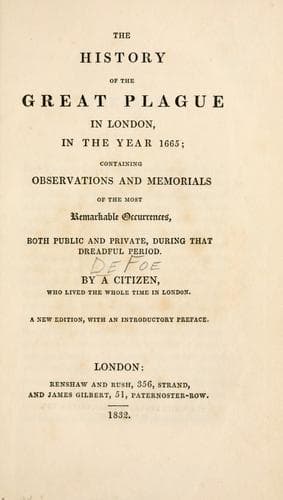
Historical fiction; London (England) -- History -- 17th century -- Fiction; Plague -- Fiction
This was well considered in those days, and I have heard them talk of it
often. The magistrates had enough to do to bring people to submit to
having their houses shut up; and many ways they deceived the watchmen,
and got out, as I observed. But that difficulty made it apparent that
they would have found it impracticable to have gone the other way to
work; for they could never have forced the sick people out of their beds
and out of their dwellings: it must not have been my lord mayor's
officers, but an army of officers, that must have attempted it. And the
people, on the other hand, would have been enraged and desperate, and
would have killed those that should have offered to have meddled with
them or with their children and relations, whatever had befallen them
for it; so that they would have made the people (who, as it was, were in
the most terrible distraction imaginable), I say, they would have made
them stark mad: whereas the magistrates found it proper on several
occasions to treat them with lenity and compassion, and not with
violence and terror, such as dragging the sick out of their houses, or
obliging them to remove themselves, would have been.
This leads me again to mention the time when the plague first
began,[254] that is to say, when it became certain that it would spread
over the whole town, when, as I have said, the better sort of people
first took the alarm, and began to hurry themselves out of town. It was
true, as I observed in its place, that the throng was so great, and the
coaches, horses, wagons, and carts were so many, driving and dragging
the people away, that it looked as if all the city was running away; and
had any regulations been published that had been terrifying at that
time, especially such as would pretend to dispose of the people
otherwise than they would dispose of themselves, it would have put both
the city and suburbs into the utmost confusion.
The magistrates wisely caused the people to be encouraged, made very
good by-laws[255] for the regulating the citizens, keeping good order in
the streets, and making everything as eligible as possible to all sorts
of people.
In the first place, the lord mayor and the sheriffs,[256] the court of
aldermen, and a certain number of the common councilmen, or their
deputies, came to a resolution, and published it; viz., that they would
not quit the city themselves, but that they would be always at hand for
the preserving good order in every place, and for doing justice on all
occasions, as also for the distributing the public charity to the poor,
and, in a word, for the doing the duty and discharging the trust reposed
in them by the citizens, to the utmost of their power.
Public-domain text, read in full here on John Shaqi.
Reviews
Reviews
No reviews yet
Be the first to share your thoughts on this work.
Elsewhere in the archive
Join the Discussion
Join the discussion
Sign in to leave a comment or review.
Sign InorCreate an account