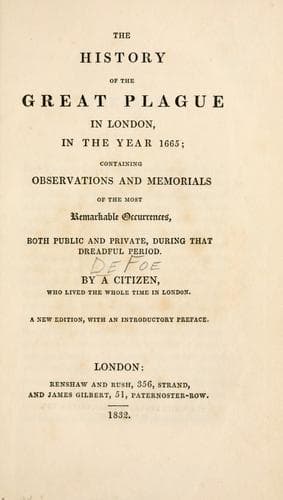
Historical fiction; London (England) -- History -- 17th century -- Fiction; Plague -- Fiction
In all this dreadful visitation there were, as I have said before, but
two pesthouses made use of; viz., one in the fields beyond Old Street,
and one in Westminster. Neither was there any compulsion used in
carrying people thither. Indeed, there was no need of compulsion in the
case, for there were thousands of poor distressed people, who having no
help, or conveniences, or supplies, but of charity, would have been very
glad to have been carried thither and been taken care of; which, indeed,
was the only thing that, I think, was wanting in the whole public
management of the city, seeing nobody was here allowed to be brought to
the pesthouse but where money was given, or security for money, either
at their introducing,[252] or upon their being cured and sent out; for
very many were sent out again whole, and very good physicians were
appointed to those places; so that many people did very well there, of
which I shall make mention again. The principal sort of people sent
thither were, as I have said, servants, who got the distemper by going
of errands to fetch necessaries for the families where they lived, and
who, in that case, if they came home sick, were removed to preserve the
rest of the house; and they were so well looked after there, in all the
time of the visitation, that there was but one hundred and fifty-six
buried in all at the London pesthouse, and one hundred and fifty-nine at
that of Westminster.
By having more pesthouses, I am far from meaning a forcing all people
into such places. Had the shutting up of houses been omitted, and the
sick hurried out of their dwellings to pesthouses, as some proposed it
seems at that time as well as since, it[253] would certainly have been
much worse than it was. The very removing the sick would have been a
spreading of the infection, and the rather because that removing could
not effectually clear the house where the sick person was of the
distemper; and the rest of the family, being then left at liberty, would
certainly spread it among others.
The methods, also, in private families which would have been universally
used to have concealed the distemper, and to have concealed the persons
being sick, would have been such that the distemper would sometimes have
seized a whole family before any visitors or examiners could have known
of it. On the other hand, the prodigious numbers which would have been
sick at a time would have exceeded all the capacity of public pesthouses
to receive them, or of public officers to discover and remove them.
Public-domain text, read in full here on John Shaqi.
Reviews
Reviews
No reviews yet
Be the first to share your thoughts on this work.
Elsewhere in the archive
Join the Discussion
Join the discussion
Sign in to leave a comment or review.
Sign InorCreate an account