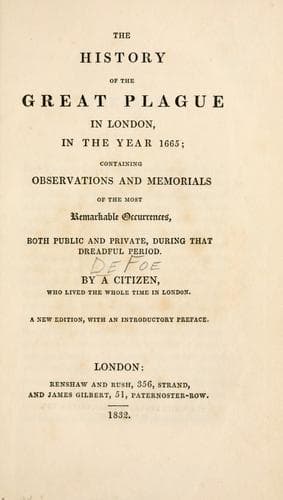
Historical fiction; London (England) -- History -- 17th century -- Fiction; Plague -- Fiction
It might be, also, that the infection might remain in other parts of the
same parcel of goods which at first it came in, and which might not be,
perhaps, opened, or at least not fully, or in the clothes of the first
infected person; for I cannot think that anybody could be seized with
the contagion in a fatal and mortal degree for nine weeks together, and
support his state of health so well as even not to discover it to
themselves:[281] yet, if it were so, the argument is the stronger in
favor of what I am saying, namely, that the infection is retained in
bodies apparently well, and conveyed from them to those they converse
with, while it is known to neither the one nor the other.
Great were the confusions at that time upon this very account; and when
people began to be convinced that the infection was received in this
surprising manner from persons apparently well, they began to be
exceeding shy and jealous of every one that came near them. Once, on a
public day, whether a sabbath day or not I do not remember, in Aldgate
Church, in a pew full of people, on a sudden one fancied she smelt an
ill smell. Immediately she fancies the plague was in the pew, whispers
her notion or suspicion to the next, then rises and goes out of the pew.
It immediately took with the next, and so with them all; and every one
of them, and of the two or three adjoining pews, got up and went out of
the church, nobody knowing what it was offended them, or from whom.
This immediately filled everybody's mouths with one preparation or
other, such as the old women directed, and some, perhaps, as physicians
directed, in order to prevent infection by the breath of others;
insomuch, that if we came to go into a church when it was anything full
of people, there would be such a mixture of smells at the entrance, that
it was much more strong, though perhaps not so wholesome, than if you
were going into an apothecary's or druggist's shop: in a word, the whole
church was like a smelling bottle. In one corner it was all perfumes; in
another, aromatics,[282] balsamics,[283] and a variety of drugs and
herbs; in another, salts and spirits, as every one was furnished for
their own preservation. Yet I observed that after people were possessed,
as I have said, with the belief, or rather assurance, of the infection
being thus carried on by persons apparently in health, the churches and
meetinghouses were much thinner of people than at other times, before
that, they used to be; for this is to be said of the people of London,
that, during the whole time of the pestilence, the churches or meetings
were never wholly shut up, nor did the people decline coming out to the
public worship of God, except only in some parishes, when the violence
of the distemper was more particularly in that parish at that time, and
even then[284] no longer than it[285] continued to be so.
Public-domain text, read in full here on John Shaqi.
Reviews
Reviews
No reviews yet
Be the first to share your thoughts on this work.
Elsewhere in the archive
Join the Discussion
Join the discussion
Sign in to leave a comment or review.
Sign InorCreate an account