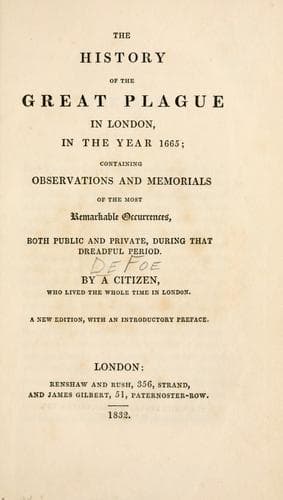
Historical fiction; London (England) -- History -- 17th century -- Fiction; Plague -- Fiction
Indeed, nothing was more strange than to see with what courage the
people went to the public service of God, even at that time when they
were afraid to stir out of their own houses upon any other occasion
(this I mean before the time of desperation which I have mentioned
already). This was a proof of the exceeding populousness of the city at
the time of the infection, notwithstanding the great numbers that were
gone into the country at the first alarm, and that fled out into the
forests and woods when they were further terrified with the
extraordinary increase of it. For when we came to see the crowds and
throngs of people which appeared on the sabbath days at the churches,
and especially in those parts of the town where the plague was abated,
or where it was not yet come to its height, it was amazing. But of this
I shall speak again presently. I return, in the mean time, to the
article of infecting one another at first. Before people came to right
notions of the infection and of infecting one another, people were only
shy of those that were really sick. A man with a cap upon his head, or
with cloths round his neck (which was the case of those that had
swellings there),--such was indeed frightful; but when we saw a
gentleman dressed, with his band[286] on, and his gloves in his hand,
his hat upon his head, and his hair combed,--of such we had not the
least apprehensions; and people conversed a great while freely,
especially with their neighbors and such as they knew. But when the
physicians assured us that the danger was as well from the sound (that
is, the seemingly sound) as the sick, and that those people that thought
themselves entirely free were oftentimes the most fatal; and that it
came to be generally understood that people were sensible of it, and of
the reason of it,--then, I say, they began to be jealous of everybody;
and a vast number of people locked themselves up, so as not to come
abroad into any company at all, nor suffer any that had been abroad in
promiscuous company to come into their houses, or near them (at least
not so near them as to be within the reach of their breath, or of any
smell from them); and when they were obliged to converse at a distance
with strangers, they would always have preservatives in their mouths and
about their clothes, to repel and keep off the infection.
It must be acknowledged that when people began to use these cautions
they were less exposed to danger, and the infection did not break into
such houses so furiously as it did into others before; and thousands of
families were preserved, speaking with due reserve to the direction of
Divine Providence, by that means.
Public-domain text, read in full here on John Shaqi.
Reviews
Reviews
No reviews yet
Be the first to share your thoughts on this work.
Elsewhere in the archive
Join the Discussion
Join the discussion
Sign in to leave a comment or review.
Sign InorCreate an account