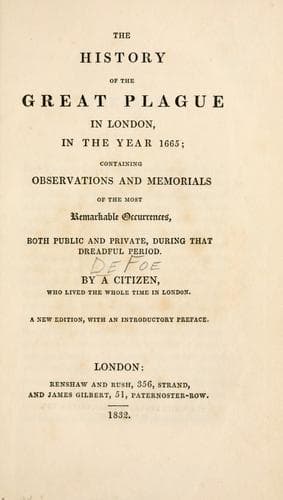
Historical fiction; London (England) -- History -- 17th century -- Fiction; Plague -- Fiction
There was also a very good trade from the coast of Suffolk, with corn,
butter, and cheese. These vessels kept a constant course of trade, and
without interruption came up to that market known still by the name of
Bear Key, where they supplied the city plentifully with corn when land
carriage began to fail, and when the people began to be sick of coming
from many places in the country.
This also was much of it owing to the prudence and conduct of the lord
mayor, who took such care to keep the masters and seamen from danger
when they came up, causing their corn to be bought off at any time they
wanted a market (which, however, was very seldom), and causing the
cornfactors[300] immediately to unlade and deliver the vessels laden
with corn, that they had very little occasion to come out of their ships
or vessels, the money being always carried on board to them, and put it
into a pail of vinegar before it was carried.
The second trade was that of coals from Newcastle-upon-Tyne, without
which the city would have been greatly distressed; for not in the
streets only, but in private houses and families, great quantities of
coal were then burnt, even all the summer long, and when the weather was
hottest, which was done by the advice of the physicians. Some, indeed,
opposed it, and insisted that to keep the houses and rooms hot was a
means to propagate the distemper, which was a fermentation and heat
already in the blood; that it was known to spread and increase in hot
weather, and abate in cold; and therefore they alleged that all
contagious distempers are the worst for heat, because the contagion was
nourished, and gained strength, in hot weather, and was, as it were,
propagated in heat.
Others said they granted that heat in the climate might propagate
infection, as sultry hot weather fills the air with vermin, and
nourishes innumerable numbers and kinds of venomous creatures, which
breed in our food, in the plants, and even in our bodies, by the very
stench of which infection may be propagated; also that heat in the air,
or heat of weather, as we ordinarily call it, makes bodies relax and
faint, exhausts the spirits, opens the pores, and makes us more apt to
receive infection or any evil influence, be it from noxious,
pestilential vapors, or any other thing in the air; but that the heat of
fire, and especially of coal fires, kept in our houses or near us, had
quite a different operation, the heat being not of the same kind, but
quick and fierce, tending not to nourish, but to consume and dissipate,
all those noxious fumes which the other kind of heat rather exhaled, and
stagnated than separated, and burnt up. Besides, it was alleged that the
sulphureous and nitrous particles that are often found to be in the
coal, with that bituminous substance which burns, are all assisting to
clear and purge the air, and render it wholesome and safe to breathe
in, after the noxious particles (as above) are dispersed and burnt up.
Public-domain text, read in full here on John Shaqi.
Reviews
Reviews
No reviews yet
Be the first to share your thoughts on this work.
Elsewhere in the archive
Join the Discussion
Join the discussion
Sign in to leave a comment or review.
Sign InorCreate an account