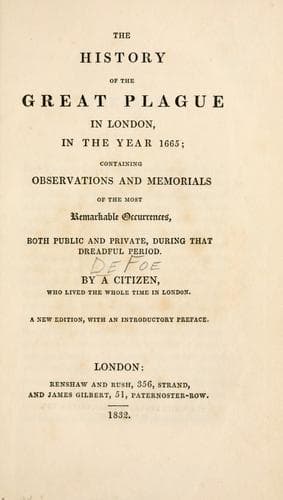
Historical fiction; London (England) -- History -- 17th century -- Fiction; Plague -- Fiction
The latter opinion prevailed at that time, and, as I must confess, I
think with good reason; and the experience of the citizens confirmed it,
many houses which had constant fires kept in the rooms having never been
infected at all; and I must join my experience to it, for I found the
keeping of good fires kept our rooms sweet and wholesome, and I do
verily believe made our whole family so, more than would otherwise have
been.
But I return to the coals as a trade. It was with no little difficulty
that this trade was kept open, and particularly because, as we were in
an open war with the Dutch at that time, the Dutch capers[301] at first
took a great many of our collier ships, which made the rest cautious,
and made them to stay to come in fleets together. But after some time
the capers were either afraid to take them, or their masters, the
States, were afraid they should, and forbade them, lest the plague
should be among them, which made them fare the better.
For the security of those northern traders, the coal ships were ordered
by my lord mayor not to come up into the Pool above a certain number at
a time; and[302] ordered lighters and other vessels, such as the
woodmongers (that is, the wharf keepers) or coal sellers furnished, to
go down and take out the coals as low as Deptford and Greenwich, and
some farther down.
Others delivered great quantities of coals in particular places where
the ships could come to the shore, as at Greenwich, Blackwall, and other
places, in vast heaps, as if to be kept for sale; but[303] were then
fetched away after the ships which brought them were gone; so that the
seamen had no communication with the river men, nor so much as came near
one another.[304]
Yet all this caution could not effectually prevent the distemper
getting among the colliery, that is to say, among the ships, by which a
great many seamen died of it; and that which was still worse was, that
they carried it down to Ipswich and Yarmouth, to Newcastle-upon-Tyne,
and other places on the coast, where, especially at Newcastle and at
Sunderland, it carried off a great number of people.
The making so many fires as above did indeed consume an unusual quantity
of coals; and that upon one or two stops of the ships coming up (whether
by contrary weather or by the interruption of enemies, I do not
remember); but the price of coals was exceedingly dear, even as high as
four pounds a chaldron;[305] but it soon abated when the ships came in,
and, as afterwards they had a freer passage, the price was very
reasonable all the rest of that year.
The public fires which were made on these occasions, as I have
calculated it, must necessarily have cost the city about two hundred
chaldron of coals a week, if they had continued, which was indeed a very
great quantity; but as it was thought necessary, nothing was spared.
However, as some of the physicians cried them down, they were not kept
alight above four or five days. The fires were ordered thus:--
Public-domain text, read in full here on John Shaqi.
Reviews
Reviews
No reviews yet
Be the first to share your thoughts on this work.
Elsewhere in the archive
Join the Discussion
Join the discussion
Sign in to leave a comment or review.
Sign InorCreate an account