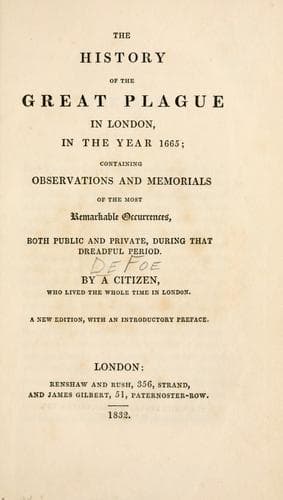
Historical fiction; London (England) -- History -- 17th century -- Fiction; Plague -- Fiction
It was not the least of our misfortunes, that with our infection, when
it ceased, there did not cease the spirit of strife and contention,
slander and reproach, which was really the great troubler of the
nation's peace before. It was said to be the remains of the old
animosities which had so lately involved us all in blood and
disorder;[327] but as the late act of indemnity[328] had lain asleep the
quarrel itself, so the government had recommended family and personal
peace, upon all occasions, to the whole nation.
But it[329] could not be obtained; and particularly after the ceasing
of the plague in London, when any one had seen the condition which the
people had been in, and how they caressed one another at that time,
promised to have more charity for the future, and to raise no more
reproaches,--I say, any one that had seen them then would have thought
they would have come together with another spirit at last. But, I say,
it could not be obtained. The quarrel remained, the Church[330] and the
Presbyterians were incompatible. As soon as the plague was removed, the
dissenting ousted ministers who had supplied the pulpits which were
deserted by the incumbents, retired. They[331] could expect no other but
that they[332] should immediately fall upon them[331] and harass them
with their penal laws; accept their[331] preaching while they[332] were
sick, and persecute them[331] as soon as they[332] were recovered again.
This even we that were of the Church thought was hard, and could by no
means approve of it.
But it was the government, and we could say nothing to hinder it. We
could only say it was not our doing, and we could not answer for it.
On the other hand, the dissenters reproaching those ministers of the
Church with going away, and deserting their charge, abandoning the
people in their danger, and when they had most need of comfort, and the
like,--this we could by no means approve; for all men have not the same
faith and the same courage, and the Scripture commands us to judge the
most favorably, and according to charity.
A plague is a formidable enemy, and is armed with terrors that every man
is not sufficiently fortified to resist, or prepared to stand the shock
against.[333] It is very certain that a great many of the clergy who
were in circumstances to do it withdrew, and fled for the safety of
their lives; but it is true, also, that a great many of them staid, and
many of them fell in the calamity, and in the discharge of their duty.
Public-domain text, read in full here on John Shaqi.
Reviews
Reviews
No reviews yet
Be the first to share your thoughts on this work.
Elsewhere in the archive
Join the Discussion
Join the discussion
Sign in to leave a comment or review.
Sign InorCreate an account