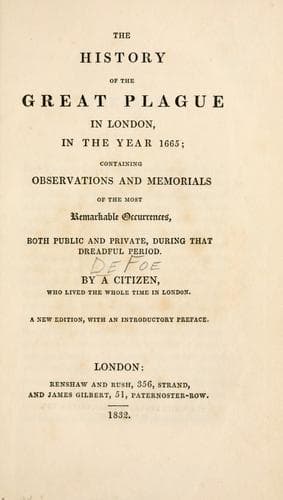
Historical fiction; London (England) -- History -- 17th century -- Fiction; Plague -- Fiction
It is true, some of the dissenting turned-out ministers staid, and
their courage is to be commended and highly valued; but these were not
abundance. It cannot be said that they all staid, and that none retired
into the country, any more than it can be said of the Church clergy that
they all went away. Neither did all those that went away go without
substituting curates[334] and others in their places, to do the offices
needful, and to visit the sick as far as it was practicable. So that,
upon the whole, an allowance of charity might have been made on both
sides, and we should have considered that such a time as this of 1665 is
not to be paralleled in history, and that it is not the stoutest courage
that will always support men in such cases. I had not said this, but had
rather chosen[335] to record the courage and religious zeal of those of
both sides who did hazard themselves for the service of the poor people
in their distress, without remembering that any failed in their duty on
either side; but the want of temper among us has made the contrary to
this necessary: some that staid, not only boasting too much of
themselves, but reviling those that fled, branding them with cowardice,
deserting their flocks, and acting the part of the hireling, and the
like. I recommend it to the charity of all good people to look back and
reflect duly upon the terrors of the time; and whoever does so will see
that it is not an ordinary strength that could support it. It was not
like appearing in the head of an army, or charging a body of horse in
the field; but it was charging death itself on his pale horse.[336] To
stay was indeed to die; and it could be esteemed nothing less,
especially as things appeared at the latter end of August and the
beginning of September, and as there was reason to expect them at that
time; for no man expected, and I dare say believed, that the distemper
would take so sudden a turn as it did, and fall immediately two
thousand in a week, when there was such a prodigious number of people
sick at that time as it was known there was; and then it was that many
shifted[337] away that had staid most of the time before.
Besides, if God gave strength to some more than to others, was it to
boast of their ability to abide the stroke, and upbraid those that had
not the same gift and support, or ought they not rather to have been
humble and thankful if they were rendered more useful than their
brethren?
I think it ought to be recorded to the honor of such men, as well clergy
as physicians, surgeons, apothecaries, magistrates, and officers of
every kind, as also all useful people, who ventured their lives in
discharge of their duty, as most certainly all such as staid did to the
last degree; and several of these kinds did not only venture, but lost
their lives on that sad occasion.
Public-domain text, read in full here on John Shaqi.
Reviews
Reviews
No reviews yet
Be the first to share your thoughts on this work.
Elsewhere in the archive
Join the Discussion
Join the discussion
Sign in to leave a comment or review.
Sign InorCreate an account