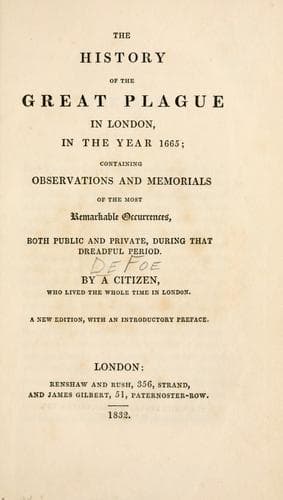
Historical fiction; London (England) -- History -- 17th century -- Fiction; Plague -- Fiction
I was once making a list of all such (I mean of all those professions
and employments who thus died, as I call it, in the way of their duty),
but it was impossible for a private man to come at a certainty in the
particulars. I only remember that there died sixteen clergymen, two
aldermen, five physicians, thirteen surgeons, within the city and
liberties, before the beginning of September. But this being, as I said
before, the crisis and extremity of the infection, it can be no complete
list. As to inferior people, I think there died six and forty constables
and headboroughs[338] in the two parishes of Stepney and Whitechapel;
but I could not carry my list on, for when the violent rage of the
distemper, in September, came upon us, it drove us out of all measure.
Men did then no more die by tale[339] and by number: they might put out
a weekly bill, and call them seven or eight thousand, or what they
pleased. It is certain they died by heaps, and were buried by heaps;
that is to say, without account. And if I might believe some people who
were more abroad and more conversant with those things than I (though I
was public enough for one that had no more business to do than I
had),--I say, if we may believe them, there was not many less buried
those first three weeks in September than twenty thousand per week.
However the others aver the truth of it, yet I rather choose to keep to
the public account. Seven or eight thousand per week is enough to make
good all that I have said of the terror of those times; and it is much
to the satisfaction of me that write, as well as those that read, to be
able to say that everything is set down with moderation, and rather
within compass than beyond it.
Upon all these accounts, I say, I could wish, when we were recovered,
our conduct had been more distinguished for charity and kindness, in
remembrance of the past calamity, and not so much in valuing ourselves
upon our boldness in staying; as if all men were cowards that fly from
the hand of God, or that those who stay do not sometimes owe their
courage to their ignorance, and despising the hand of their Maker, which
is a criminal kind of desperation, and not a true courage.
I cannot but leave it upon record, that the civil officers, such as
constables, headboroughs, lord mayor's and sheriff's men, also parish
officers, whose business it was to take charge of the poor, did their
duties, in general, with as much courage as any, and perhaps with more;
because their work was attended with more hazards, and lay more among
the poor, who were more subject to be infected, and in the most pitiful
plight when they were taken with the infection. But then it must be
added, too, that a great number of them died; indeed, it was scarcely
possible it should be otherwise.
Public-domain text, read in full here on John Shaqi.
Reviews
Reviews
No reviews yet
Be the first to share your thoughts on this work.
Elsewhere in the archive
Join the Discussion
Join the discussion
Sign in to leave a comment or review.
Sign InorCreate an account