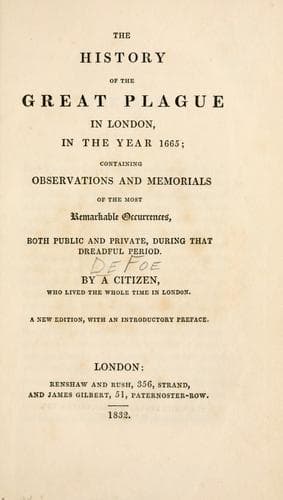
Historical fiction; London (England) -- History -- 17th century -- Fiction; Plague -- Fiction
This, however, is certain, not a man of them appeared for a great while
in or about London. There were indeed several doctors who published
bills recommending their several physical preparations for cleansing the
body, as they call it, after the plague, and needful, as they said, for
such people to take who had been visited and had been cured; whereas, I
must own, I believe that it was the opinion of the most eminent
physicians of that time, that the plague was itself a sufficient purge,
and that those who escaped the infection needed no physic to cleanse
their bodies of any other things (the running sores, the tumors, etc.,
which were broken and kept open by the direction of the physicians,
having sufficiently cleansed them); and that all other distempers, and
causes of distempers, were effectually carried off that way. And as the
physicians gave this as their opinion wherever they came, the quacks got
little business.
There were indeed several little hurries which happened after the
decrease of the plague, and which, whether they were contrived to fright
and disorder the people, as some imagined, I cannot say; but sometimes
we were told the plague would return by such a time; and the famous
Solomon Eagle, the naked Quaker I have mentioned, prophesied evil
tidings every day, and several others, telling us that London had not
been sufficiently scourged, and the sorer and severer strokes were yet
behind. Had they stopped there, or had they descended to particulars,
and told us that the city should be the next year destroyed by fire,
then, indeed, when we had seen it come to pass, we should not have been
to blame to have paid more than common respect to their prophetic
spirits (at least, we should have wondered at them, and have been more
serious in our inquiries after the meaning of it, and whence they had
the foreknowledge); but as they generally told us of a relapse into the
plague, we have had no concern since that about them. Yet by those
frequent clamors we were all kept with some kind of apprehensions
constantly upon us; and if any died suddenly, or if the spotted fevers
at any time increased, we were presently alarmed; much more if the
number of the plague increased, for to the end of the year there were
always between two and three hundred[342] of the plague. On any of these
occasions, I say, we were alarmed anew.
Those who remember the city of London before the fire must remember that
there was then no such place as that we now call Newgate Market; but in
the middle of the street, which is now called Blow Bladder Street, and
which had its name from the butchers, who used to kill and dress their
sheep there (and who, it seems, had a custom to blow up their meat with
pipes, to make it look thicker and fatter than it was, and were punished
there for it by the lord mayor),--I say, from the end of the street
towards Newgate there stood two long rows of shambles for the
selling[343] meat.
Public-domain text, read in full here on John Shaqi.
Reviews
Reviews
No reviews yet
Be the first to share your thoughts on this work.
Elsewhere in the archive
Join the Discussion
Join the discussion
Sign in to leave a comment or review.
Sign InorCreate an account