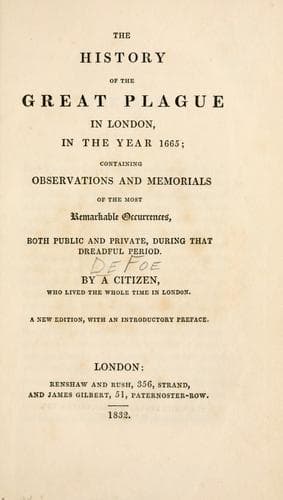
Historical fiction; London (England) -- History -- 17th century -- Fiction; Plague -- Fiction
It was in those shambles that two persons falling down dead as they were
buying meat, gave rise to a rumor that the meat was all infected; which
though it might affright the people, and spoiled the market for two or
three days, yet it appeared plainly afterwards that there was nothing of
truth in the suggestion: but nobody can account for the possession of
fear when it takes hold of the mind. However, it pleased God, by the
continuing of the winter weather, so to restore the health of the city,
that by February following we reckoned the distemper quite ceased, and
then we were not easily frighted again.
There was still a question among the learned, and[344] at first
perplexed the people a little; and that was, in what manner to purge the
houses and goods where the plague had been, and how to render them[345]
habitable again which had been left empty during the time of the plague.
Abundance of perfumes and preparations were prescribed by physicians,
some of one kind, some of another, in which the people who listened to
them put themselves to a great, and indeed in my opinion to an
unnecessary, expense; and the poorer people, who only set open their
windows night and day, burnt brimstone, pitch, and gunpowder, and such
things, in their rooms, did as well as the best; nay, the eager people
who, as I said above, came home in haste and at all hazards, found
little or no inconvenience in their houses, nor in their goods, and did
little or nothing to them.
However, in general, prudent, cautious people did enter into some
measures for airing and sweetening their houses, and burnt perfumes,
incense, benjamin,[346] resin, and sulphur in their rooms, close shut
up, and then let the air carry it all out with a blast of gunpowder;
others caused large fires to be made all day and all night for several
days and nights. By the same token that[347] two or three were pleased
to set their houses on fire, and so effectually sweetened them by
burning them down to the ground (as particularly one at Ratcliff, one in
Holborn, and one at Westminster, besides two or three that were set on
fire; but the fire was happily got out again before it went far enough
to burn down the houses); and one citizen's servant, I think it was in
Thames Street, carried so much gunpowder into his master's house, for
clearing it of the infection, and managed it so foolishly, that he blew
up part of the roof of the house. But the time was not fully come that
the city was to be purged with fire, nor was it far off; for within nine
months more I saw it all lying in ashes, when, as some of our quaking
philosophers pretend, the seeds of the plague were entirely destroyed,
and not before,--a notion too ridiculous to speak of here, since, had
the seeds of the plague remained in the houses, not to be destroyed but
by fire, how has it been that they have not since broken out, seeing all
those buildings in the suburbs and liberties, all in the great parishes
Public-domain text, read in full here on John Shaqi.
Reviews
Reviews
No reviews yet
Be the first to share your thoughts on this work.
Elsewhere in the archive
Join the Discussion
Join the discussion
Sign in to leave a comment or review.
Sign InorCreate an account