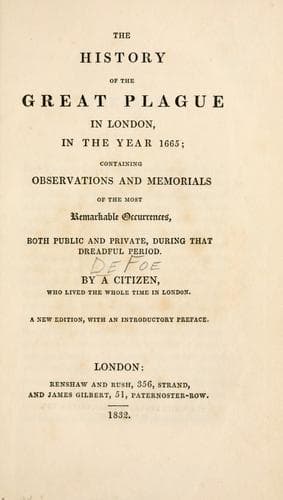
Historical fiction; London (England) -- History -- 17th century -- Fiction; Plague -- Fiction
I must confess myself to have been very much dejected just before this
happened; for the prodigious numbers that were taken sick the week or
two before, besides those that died, was[351] such, and the lamentations
were so great everywhere, that a man must have seemed to have acted even
against his reason if he had so much as expected to escape; and as there
was hardly a house but mine in all my neighborhood but what was
infected, so, had it gone on, it would not have been long that there
would have been any more neighbors to be infected. Indeed, it is hardly
credible what dreadful havoc the last three weeks had made: for, if I
might believe the person whose calculations I always found very well
grounded, there were not less than thirty thousand people dead, and near
one hundred thousand fallen sick, in the three weeks I speak of; for the
number that sickened was surprising, indeed it was astonishing, and
those whose courage upheld them all the time before, sunk under it now.
In the middle of their distress, when the condition of the city of
London was so truly calamitous, just then it pleased God, as it were, by
his immediate hand, to disarm this enemy: the poison was taken out of
the sting. It was wonderful. Even the physicians themselves were
surprised at it. Wherever they visited, they found their patients
better,--either they had sweated kindly, or the tumors were broke, or
the carbuncles went down and the inflammations round them changed color,
or the fever was gone, or the violent headache was assuaged, or some
good symptom was in the case,--so that in a few days everybody was
recovering. Whole families that were infected and down, that had
ministers praying with them, and expected death every hour, were revived
and healed, and none died at all out of them.
Nor was this by any new medicine found out, or new method of cure
discovered, or by any experience in the operation which the physicians
or surgeons attained to; but it was evidently from the secret invisible
hand of Him that had at first sent this disease as a judgment upon us.
And let the atheistic part of mankind call my saying what they please,
it is no enthusiasm: it was acknowledged at that time by all mankind.
The disease was enervated, and its malignity spent; and let it proceed
from whencesoever it will, let the philosophers search for reasons in
nature to account for it by, and labor as much as they will to lessen
the debt they owe to their Maker, those physicians who had the least
share of religion in them were obliged to acknowledge that it was all
supernatural, that it was extraordinary, and that no account could be
given of it.
Public-domain text, read in full here on John Shaqi.
Reviews
Reviews
No reviews yet
Be the first to share your thoughts on this work.
Elsewhere in the archive
Join the Discussion
Join the discussion
Sign in to leave a comment or review.
Sign InorCreate an account