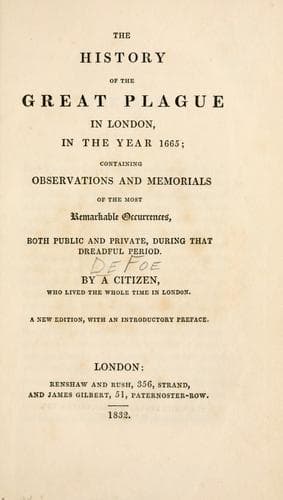
Historical fiction; London (England) -- History -- 17th century -- Fiction; Plague -- Fiction
If I should say that this is a visible summons to us all to
thankfulness, especially we that were under the terror of its increase,
perhaps it may be thought by some, after the sense of the thing was
over, an officious canting of religious things, preaching a sermon
instead of writing a history, making myself a teacher instead of giving
my observations of things (and this restrains me very much from going on
here, as I might otherwise do); but if ten lepers were healed, and but
one returned to give thanks, I desire to be as that one, and to be
thankful for myself.
Nor will I deny but there were abundance of people who, to all
appearance, were very thankful at that time: for their mouths were
stopped, even the mouths of those whose hearts were not extraordinarily
long affected with it; but the impression was so strong at that time,
that it could not be resisted, no, not by the worst of the people.
It was a common thing to meet people in the street that were strangers,
and that we knew nothing at all of, expressing their surprise. Going one
day through Aldgate, and a pretty many people being passing and
repassing, there comes a man out of the end of the Minories; and,
looking a little up the street and down, he throws his hands abroad:
"Lord, what an alteration is here! Why, last week I came along here, and
hardly anybody was to be seen." Another man (I heard him) adds to his
words, "'Tis all wonderful; 'tis all a dream."--"Blessed be God!" says a
third man; "and let us give thanks to him, for 'tis all his own doing."
Human help and human skill were at an end. These were all strangers to
one another, but such salutations as these were frequent in the street
every day; and, in spite of a loose behavior, the very common people
went along the streets, giving God thanks for their deliverance.
It was now, as I said before, the people had cast off all apprehensions,
and that too fast. Indeed, we were no more afraid now to pass by a man
with a white cap upon his head, or with a cloth wrapped round his neck,
or with his leg limping, occasioned by the sores in his groin,--all
which were frightful to the last degree but the week before. But now the
street was full of them, and these poor recovering creatures, give them
their due, appeared very sensible of their unexpected deliverance, and I
should wrong them very much if I should not acknowledge that I believe
many of them were really thankful; but I must own that for the
generality of the people it might too justly be said of them, as was
said of the children of Israel after their being delivered from the host
of Pharaoh, when they passed the Red Sea, and looked back and saw the
Egyptians overwhelmed in the water, viz., "that they sang his praise,
but they soon forgot his works."[352]
Public-domain text, read in full here on John Shaqi.
Reviews
Reviews
No reviews yet
Be the first to share your thoughts on this work.
Elsewhere in the archive
Join the Discussion
Join the discussion
Sign in to leave a comment or review.
Sign InorCreate an account