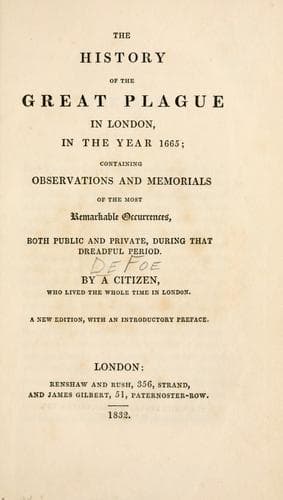
Historical fiction; London (England) -- History -- 17th century -- Fiction; Plague -- Fiction
[36] Charles II. and his courtiers. The immunity of Oxford was doubtless
due to good drainage and general cleanliness.
[37] Eccl. xii. 5.
[38] Have seen.
[39] Nor. This misuse of "or" for "nor" is frequent with Defoe.
[40] The four inns of court in London which have the exclusive right of
calling to the bar, are the Inner Temple, the Middle Temple, Lincoln's
Inn, and Gray's Inn. The Temple is so called because it was once the
home of the Knights Templars.
[41] The city proper, i.e., the part within the walls, as distinguished
from that without.
[42] Were.
[43] The population of London at this time was probably about half a
million. It is now about six millions. (See Macaulay's History, chap.
iii.)
[44] Acel'dama, the field of blood (see Matt. xxvii. 8).
[45] Phlegmatic hypochondriac is a contradiction in terms; for
"phlegmatic" means "impassive, self-restrained," while "hypochondriac"
means "morbidly anxious" (about one's health). Defoe's lack of
scholarship was a common jest among his more learned adversaries, such
as Swift, and Pope.
[46] It was in this very plague year that Newton formulated his theory
of gravitation. Incredible as it may seem, at this same date even such
men as Dryden held to a belief in astrology.
[47] William Lilly was the most famous astrologer and almanac maker of
the time. In Butler's Hudibras he is satirized under the name of
Sidrophel.
[48] Poor Robin's Almanack was first published in 1661 or 1662, and was
ascribed to Robert Herrick, the poet.
[49] See Rev. xviii. 4.
[50] Jonah iii. 4.
[51] Flavius Josephus, the author of the History of the Jewish Wars. He
is supposed to have died in the last decade of the first century A.D.
[52] So called because many Frenchmen lived there. In Westminster there
was another district with this same name.
[53] "Gave them vapors," i.e., put them into a state of nervous
excitement.
[54] Soothsayers.
[55] In astrology, the scheme or figure of the heavens at the moment of
a person's birth. From this the astrologers pretended to foretell a
man's destiny.
[56] Roger Bacon, a Franciscan friar of the thirteenth century, had a
knowledge of mechanics and optics far in advance of his age: hence he
was commonly regarded as a wizard. The brazen head which he manufactured
was supposed to assist him in his necromantic feats; it is so introduced
by Greene in his play of Friar Bacon and Friar Bungay (1594).
[57] A fortune teller who lived in the reign of Henry VIII., and was
famous for her prophecies.
[58] The most celebrated magician of mediaeval times (see Spenser's
Faerie Queene and Tennyson's Merlin and Vivien).
[59] Linen collar or ruff.
[60] Him.
[61] The interlude was originally a short, humorous play acted in the
midst of a morality play to relieve the tedium of that very tedious
performance. From the interlude was developed farce; and from farce,
comedy.
Public-domain text, read in full here on John Shaqi.
Reviews
Reviews
No reviews yet
Be the first to share your thoughts on this work.
Elsewhere in the archive
Join the Discussion
Join the discussion
Sign in to leave a comment or review.
Sign InorCreate an account