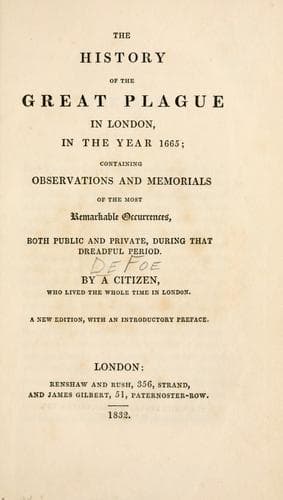
Historical fiction; London (England) -- History -- 17th century -- Fiction; Plague -- Fiction
[62] Charles II. and his courtiers, from their long exile in France,
brought back to England with them French fashions in literature and in
art.
[63] To be acted.
[64] Buffoons, clowns.
[65] About 621/2 cents.
[66] About twenty-five dollars; but the purchasing power of money was
then seven or eight times what it is now.
[67] Strictly speaking, this word means "love potions."
[68] Exorcism is the act of expelling evil spirits, or the formula used
in the act. Defoe's use of the word here is careless and inaccurate.
[69] Bits of metal, parchment, etc., worn as charms.
[70] Making the sign of the cross.
[71] Paper on which were marked the signs of the zodiac,--a superstition
from astrology.
[72] A meaningless word used in incantations. Originally the name of a
Syrian deity.
[73] Iesus Hominum Salvator ("Jesus, Savior of Men"). The order of the
Jesuits was founded by Ignatius de Loyola in 1534.
[74] The Feast of St. Michael, Sept. 29.
[75] This use of "to" for "of" is frequent with Defoe.
[76] The Royal College of Physicians was founded by Thomas Linacre,
physician to Henry VIII. Nearly every London physician of prominence is
a member.
[77] The city of London proper lies entirely in the county of Middlesex.
[78] Literally, "hand workers;" now contracted into "surgeons."
[79] Cares, duties.
[80] Consenting knowledge.
[81] Disposed of to the public, put in circulation.
[82] That is, by the disease.
[83] Happen.
[84] Engaged.
[85] Heaps of rubbish.
[86] A kind of parish constable.
[87] The writer seems to mean that the beggars are so importunate, there
is no avoiding them.
[88] Fights between dogs and bears. This was not declared a criminal
offense in England until 1835.
[89] Contests with sword and shield.
[90] The guilds or organizations of tradesmen, such as the goldsmiths,
the fishmongers, the merchant tailors.
[91] St. Katherine's by the Tower.
[92] Trinity (east of the) Minories. The Minories (a street running
north from the Tower) was so designated from an abbey of St. Clare nuns
called Minoresses. They took their name from that of the Franciscan
Order, Fratres Minores, or Lesser Brethren.
[93] St. Luke's.
[94] St. Botolph's, Bishopsgate.
[95] St. Giles's, Cripplegate.
[96] Were.
[97] Chemise.
[98] This word is misplaced; it should go before "perish."
[99] Before "having," supply "the master."
[100] Fences.
[101] From.
[102] This old form for "caught" is used frequently by Defoe.
[103] Came to grief.
[104] "Who, being," etc., i.e., who, although single men, had yet staid.
[105] The wars of the Commonwealth or of the Puritan Revolution,
1640-52.
[106] Holland and Belgium.
[107] "Hurt of," a common form of expression used in Defoe's time.
[108] Manager, economist. This meaning of "husband" is obsolete.
[109] A participial form of expression very common in Old English, the
"a" being a corruption of "in" or "on."
[110] Were.
[111] "'Name of God," i.e., in the name of God.
[112] Torches.
Public-domain text, read in full here on John Shaqi.
Reviews
Reviews
No reviews yet
Be the first to share your thoughts on this work.
Elsewhere in the archive
Join the Discussion
Join the discussion
Sign in to leave a comment or review.
Sign InorCreate an account