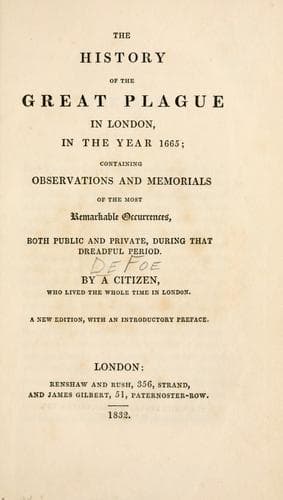
Historical fiction; London (England) -- History -- 17th century -- Fiction; Plague -- Fiction
[113] "To and again," i.e., to and fro.
[114] Were.
[115] As if.
[116] Magpie.
[117] This word is from the same root as "lamp." The old form "lanthorn"
crept in from the custom of making the sides of a lantern of horn.
[118] Supply "be."
[119] Inclination.
[120] In expectation of the time when.
[121] Their being checked.
[122] This paragraph could hardly have been more clumsily expressed. It
will be found a useful exercise to rewrite it.
[123] "To have gone," i.e., to go.
[124] Spotted.
[125] "Make shift," i.e., endure it.
[126] Device, expedient.
[127] "In all" is evidently a repetition.
[128] Objects cannot very well happen. Defoe must mean, "the many dismal
sights I saw as I went about the streets."
[129] As.
[130] "Rosin" is a long-established misspelling for "resin." Resin
exudes from pine trees, and from it the oil of turpentine is separated
by distillation.
[131] As distinguished from fish meat.
[132] Defoe uses these pronouns in the wrong number, as in numerous
other instances.
[133] The projecting part of a building.
[134] Their miraculous preservation was wrought by their keeping in the
fresh air of the open fields. It seems curious that after this object
lesson the physicians persisted in their absurd policy of shutting up
infected houses, thus practically condemning to death their inmates.
[135] Used here for "this," as also in many other places.
[136] Supply "with."
[137] Such touches as this created a widespread and long-enduring belief
that Defoe's fictitious diary was an authentic history.
[138] "Running out," etc., i.e., losing their self-control.
[139] Idiocy. In modern English, "idiotism" is the same as "idiom."
[140] Gangrene, death of the soft tissues.
[141] Before "that" supply "we have been told."
[142] Hanging was at this time a common punishment for theft. In his
novel Moll Flanders, Defoe has a vivid picture of the mental and
physical sufferings of a woman who was sent to Newgate, and condemned to
death, for stealing two pieces of silk.
[143] Cloth, rag.
[144] They could no longer give them regular funerals, but had to bury
them promiscuously in pits.
[145] Evidently a repetition.
[146] In old and middle English two negatives did not make an
affirmative, as they do in modern English.
[147] It is now well known that rue has no qualities that are useful for
warding off contagion.
[148] "Set up," i.e., began to play upon.
[149] Constrained.
[150] Because they would have been refused admission to other ports.
[151] Matter. So used by Sheridan in The Rivals, act iii. sc. 2.
[152] Probably a misprint for "greatly."
[153] This.
[154] Are.
[155] He has really given two days more than two months.
[156] A count.
[157] Range, limits.
[158] Unknown.
[159] Lying.
[160] Was.
[161] Notice this skillful touch to give verisimilitude to the
narrative.
[162] Country.
[163] "Without the bars," i.e., outside the old city limits.
[164] Profession.
[165] The plague.
Public-domain text, read in full here on John Shaqi.
Reviews
Reviews
No reviews yet
Be the first to share your thoughts on this work.
Elsewhere in the archive
Join the Discussion
Join the discussion
Sign in to leave a comment or review.
Sign InorCreate an account