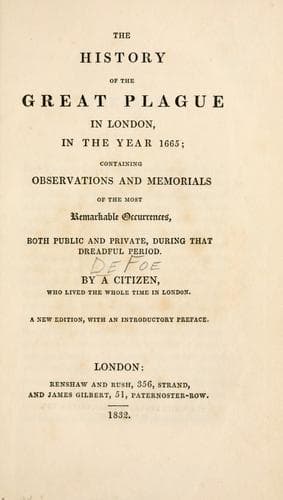
Historical fiction; London (England) -- History -- 17th century -- Fiction; Plague -- Fiction
[224] Two heavy timbers placed horizontally, the upper one of which can
be raised. When lowered, it is held in place by a padlock. Notches in
the timbers form holes, through which the prisoner's legs are thrust,
and held securely.
[225] The constables.
[226] The carters.
[227] The goods.
[228] In spite of, notwithstanding.
[229] Supply "who."
[230] "Cum aliis," i.e., with others. Most of the places mentioned in
this list are several miles distant from London: for example, Enfield is
ten miles northeast; Hadley, over fifty miles northeast; Hertford,
twenty miles north; Kingston, ten miles southwest; St. Albans, twenty
miles northwest; Uxbridge, fifteen miles west; Windsor, twenty miles
west; etc.
[231] Kindly regarded.
[232] Which.
[233] The citizens.
[234] Such statements.
[235] For "so that," substitute "so."
[236] How.
[237] It was not known in Defoe's time that minute disease germs may be
carried along by a current of air.
[238] Affected with scurvy.
[239] "Which," as applied to persons, is a good Old English idiom, and
was in common use as late as 1711 (see Spectator No. 78; and Matt. vi.
9, version of 1611).
[240] Flung to.
[241] Changed their garments.
[242] Supply "I heard."
[243] At.
[244] Various periods are assigned for the duration of the dog days:
perhaps July 3 to Aug. 11 is that most commonly accepted. The dog days
were so called because they coincided with the heliacal rising of Sirius
or Canicula (the little dog).
[245] An inn with this title (and probably a picture of the brothers)
painted on its signboard.
[246] Whom.
[247] The Act of Uniformity was passed in 1661. It required all
municipal officers and all ministers to take the communion according to
the ritual of the Church of England, and to sign a document declaring
that arms must never be borne against the King. For refusing obedience
to this tyrannical measure, some two thousand Presbyterian ministers
were deprived of their livings.
[248] Madness, as in Hamlet, act iii. sc. 1.
[249] "Represented themselves," etc., i.e., presented themselves to my
sight.
[250] "Dead part of the night," i.e., from midnight to dawn. Compare,
"In the dead waste and middle of the night."
_Hamlet_, act i. sc 2.
[251] "Have been critical," etc., i.e., have claimed to have knowledge
enough to say.
[252] Being introduced.
[253] The plague.
[254] "First began" is a solecism common in the newspaper writing of
to-day.
[255] Literally, laws of the _by_ (town). In modern usage, "by-law" is
used to designate a rule less general and less easily amended than a
constitutional provision.
[256] "Sheriff" is equivalent to _shire-reeve_ (magistrate of the county
or shire). London had, and still has, two sheriffs.
[257] Acted.
[258] The inspection, according to ordinance, of weights, measures, and
prices.
[259] "Pretty many," i.e., a fair number of.
[260] The officers.
[261] Were.
[262] "Falls to the serious part," i.e., begins to discourse on serious
matters.
Public-domain text, read in full here on John Shaqi.
Reviews
Reviews
No reviews yet
Be the first to share your thoughts on this work.
Elsewhere in the archive
Join the Discussion
Join the discussion
Sign in to leave a comment or review.
Sign InorCreate an account