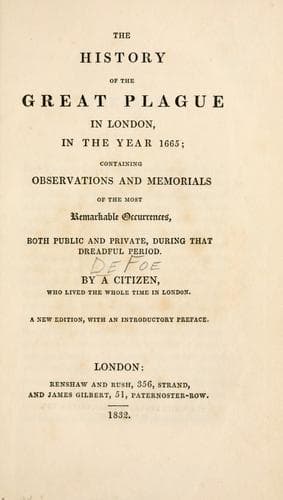
Historical fiction; London (England) -- History -- 17th century -- Fiction; Plague -- Fiction
[263] See note, p. 28. The Mohammedans are fatalists.
{Transcriber's note: The reference is to footnote 28.}
[264] A growth of osseous tissue uniting the extremities of fractured
bones.
[265] Disclosed.
[266] The officers.
[267] Leading principle.
[268] Defoe means, "can burn only a few houses." In the next line he
again misplaces "only."
[269] Put to confusion.
[270] Left out of consideration.
[271] The distemper.
[272] A means for discovering whether the person were infected or not.
[273] Defoe's ignorance of microscopes was not shared by Robert Hooke,
whose Micrographia (published in 1664) records numerous discoveries made
with that instrument.
[274] Roup is a kind of chicken's catarrh.
[275] Them, i.e., such experiments.
[276] From the Latin _quadraginta_ ("forty").
[277] From the Latin _sexaginta_ ("sixty").
[278] Kinds, species.
[279] Old age.
[280] Abscesses.
[281] Himself.
[282] The essential oils of lavender, cloves, and camphor, added to
acetic acid.
[283] In chemistry, balsams are vegetable juices consisting of resins
mixed with gums or volatile oils.
[284] Supply "they declined coming to public worship."
[285] This condition of affairs.
[286] Collar.
[287] Economy.
[288] Supply "they were."
[289] Action (obsolete in this sense). See this word as used in 2 Henry
IV., act iv. sc. 4.
[290] Which.
[291] Sailors' slang for "Archipelagoes."
[292] An important city in Asia Minor.
[293] A city in northern Syria, better known as Iskanderoon or
Alexandretta. The town was named in honor of Alexander the Great, the
Turkish form of Alexander being Iskander.
[294] Though called a kingdom, Algarve was nothing but a province of
Portugal. It is known now as Faro.
[295] The natives of Flanders, a mediaeval countship now divided among
Holland, Belgium, and France.
[296] Colonies. In the reign of Charles II., the English colonies were
governed by a committee (of the Privy Council) known as the "Council of
Plantations."
[297] The east side.
[298] On the west side.
[299] See map of England for all these places. Feversham is in Kent,
forty-five miles southeast of London; Margate is on the Isle of Thanet,
eighty miles southeast.
[300] Commission merchants.
[301] Privateers. _Capers_ is a Dutch word.
[302] Supply "he."
[303] Supply "the coals."
[304] "One another," by a confusion of constructions, has been used here
for "them."
[305] By a statute of Charles II. a chaldron was fixed at 36 coal
bushels. In the United States, it is generally 261/4 hundredweight.
[306] Opening.
[307] "To seek," i.e., without judgment or knowledge.
[308] Mixing.
[309] Him.
[310] This unwary conduct.
[311] Think.
[312] Were.
[313] Accept.
[314] Personal chattels that had occasioned the death of a human being,
and were therefore given to God (_Deo_, "to God"; _dandum_, "a thing
given"); i.e., forfeited to the King, and by him distributed in alms.
This curious law of deodands was not abolished in England until 1846.
Public-domain text, read in full here on John Shaqi.
Reviews
Reviews
No reviews yet
Be the first to share your thoughts on this work.
Elsewhere in the archive
Join the Discussion
Join the discussion
Sign in to leave a comment or review.
Sign InorCreate an account