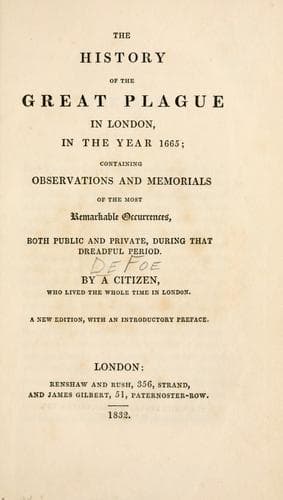
Historical fiction; London (England) -- History -- 17th century -- Fiction; Plague -- Fiction
Here the watch placed upon Bow Bridge would have questioned them; but
they, crossing the road into a narrow way that turns out of the higher
end of the town of Bow to Oldford, avoided any inquiry there, and
traveled on to Oldford. The constables everywhere were upon their guard,
not so much, it seems, to stop people passing by, as to stop them from
taking up their abode in their towns; and, withal, because of a report
that was newly raised at that time, and that indeed was not very
improbable, viz., that the poor people in London, being distressed and
starved for want of work, and by that means for want of bread, were up
in arms, and had raised a tumult, and that they would come out to all
the towns round to plunder for bread. This, I say, was only a rumor, and
it was very well it was no more; but it was not so far off from being a
reality as it has been thought, for in a few weeks more the poor people
became so desperate by the calamity they suffered, that they were with
great difficulty kept from running out into the fields and towns, and
tearing all in pieces wherever they came. And, as I have observed
before, nothing hindered them but that the plague raged so violently,
and fell in upon them so furiously, that they rather went to the grave
by thousands than into the fields in mobs by thousands; for in the parts
about the parishes of St. Sepulchre's, Clerkenwell, Cripplegate,
Bishopsgate, and Shoreditch, which were the places where the mob began
to threaten, the distemper came on so furiously, that there died in
those few parishes, even then, before the plague was come to its height,
no less than 5,361 people in the first three weeks in August, when at
the same time the parts about Wapping, Ratcliff, and Rotherhithe were,
as before described, hardly touched, or but very lightly; so that in a
word, though, as I said before, the good management of the lord mayor
and justices did much to prevent the rage and desperation of the people
from breaking out in rabbles and tumults, and, in short, from the poor
plundering the rich,--I say, though they did much, the dead cart did
more: for as I have said, that, in five parishes only, there died above
five thousand in twenty days, so there might be probably three times
that number sick all that time; for some recovered, and great numbers
fell sick every day, and died afterwards. Besides, I must still be
allowed to say, that, if the bills of mortality said five thousand, I
always believed it was twice as many in reality, there being no room to
believe that the account they gave was right, or that indeed they[196]
were, among such confusions as I saw them in, in any condition to keep
an exact account.
Public-domain text, read in full here on John Shaqi.
Reviews
Reviews
No reviews yet
Be the first to share your thoughts on this work.
Elsewhere in the archive
Join the Discussion
Join the discussion
Sign in to leave a comment or review.
Sign InorCreate an account