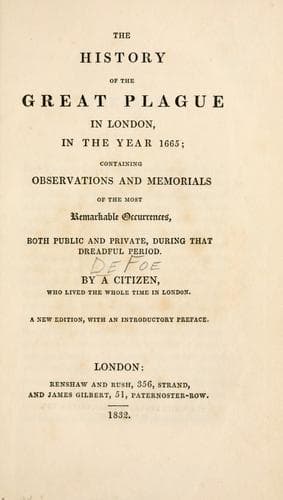
Historical fiction; London (England) -- History -- 17th century -- Fiction; Plague -- Fiction
But to return to my travelers. Here they were only examined, and, as
they seemed rather coming from the country than from the city, they
found the people easier with them; that they talked to them, let them
come into a public house where the constable and his warders were, and
gave them drink and some victuals, which greatly refreshed and
encouraged them. And here it came into their heads to say, when they
should be inquired of afterwards, not that they came from London, but
that they came out of Essex.
To forward this little fraud, they obtained so much favor of the
constable at Oldford as to give them a certificate of their passing from
Essex through that village, and that they had not been at London; which,
though false in the common acceptation of London in the country, yet was
literally true, Wapping or Ratcliff being no part either of the city or
liberty.
This certificate, directed to the next constable, that was at Homerton,
one of the hamlets of the parish of Hackney, was so serviceable to them,
that it procured them, not a free passage there only, but a full
certificate of health from a justice of the peace, who, upon the
constable's application, granted it without much difficulty. And thus
they passed through the long divided town of Hackney (for it lay then in
several separated hamlets), and traveled on till they came into the
great north road, on the top of Stamford Hill.
By this time they began to weary; and so, in the back road from Hackney,
a little before it opened into the said great road, they resolved to set
up their tent, and encamp for the first night; which they did
accordingly, with this addition: that, finding a barn, or a building
like a barn, and first searching as well as they could to be sure there
was nobody in it, they set up their tent with the head of it against the
barn. This they did also because the wind blew that night very high, and
they were but young at such a way of lodging, as well as at the managing
their tent.
Here they went to sleep; but the joiner, a grave and sober man, and not
pleased with their lying at this loose rate the first night, could not
sleep, and resolved, after trying it to no purpose, that he would get
out, and, taking the gun in his hand, stand sentinel, and guard his
companions. So, with the gun in his hand, he walked to and again before
the barn; for that stood in the field near the road, but within the
hedge. He had not been long upon the scout, but he heard a noise of
people coming on as if it had been a great number; and they came on, as
he thought, directly towards the barn. He did not presently awake his
companions, but in a few minutes more, their noise growing louder and
louder, the biscuit baker called to him and asked him what was the
matter, and quickly started out too. The other being the lame sailmaker,
and most weary, lay still in the tent.
Public-domain text, read in full here on John Shaqi.
Reviews
Reviews
No reviews yet
Be the first to share your thoughts on this work.
Elsewhere in the archive
Join the Discussion
Join the discussion
Sign in to leave a comment or review.
Sign InorCreate an account