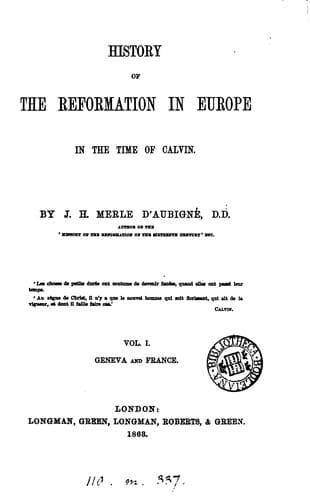
History of the Reformation in Europe in the Time of Calvin, Vol. 6 (of 8)Merle d'Aubigné, J. H. (Jean Henri)
History
History of the Reformation in Europe in the Time of Calvin, Vol. 6 (of 8)
Merle d'Aubigné, J. H. (Jean Henri)
Reformation
Beatoun assembled at St. Andrews the prelates and the nobles who
enjoyed his confidence. An elevated seat was provided for him in the
cathedral, and he sat there in his twofold character of primate and of
cardinal. The earls of Huntley, Arran, and Montrose, the earl Marshall,
and Lords Erskine, Lyndsay, Fleming, Seaton, and many other barons and
men of rank, Gawin, archbishop of Glasgow and chancellor, the bishops
of Aberdeen, Galloway, and others besides, abbots and priors, deans
and doctors of theology, were around him. David Beatoun, proud to see
beneath him that illustrious and brilliant assembly, began to speak.
He set forth with warm feeling the dangers to which the multiplication
of heretics was exposing the Roman faith: the audacity with which they
avowed their opinions, even at the court, where they found too much
support, he added, alluding thus to the famous dramatic representation
with which James had been so struck. Then impatient to show the serious
import of his words, he announced that he had cited before that
assembly Sir John Borthwick, brother of the lord of the same name,
provost of Linlithgow, who had probably had a hand in the satirical
drama. ‘This heretic gives out,’ he said, ‘that the pope has no more
authority than other bishops, that his indulgences have no other
effect than to deceive the people, that the religious orders ought to
be abolished, that all ecclesiastics are at liberty to marry, and in
short, that the Scots, blinded by their clergy, do not profess the true
faith. He reads and circulates the New Testament in English, and divers
treatises of Melanchthon, Œcolampadius, and Erasmus, and refuses to
submit to the see of Rome.’
Borthwick, instead of going to St. Andrews, set out in all haste for
England, where he was well received by Henry VIII., and was afterwards
employed by him as one of his commissioners to the princes of Germany.
But although Beatoun could not send the lamb to the slaughter, he could
at least find the way to possess himself of the fleece. On May 28 the
confiscation of Sir John’s property was pronounced and his effigy was
burnt, first at St. Andrews and two days after at Edinburgh. The fire
did him no great harm, but it served to give a certain point to the
cardinal’s discourse.[232]
Public-domain text, read in full here on John Shaqi.
Reviews
Reviews
No reviews yet
Be the first to share your thoughts on this work.
Elsewhere in the archive
Join the Discussion
Join the discussion
Sign in to leave a comment or review.
Sign InorCreate an account