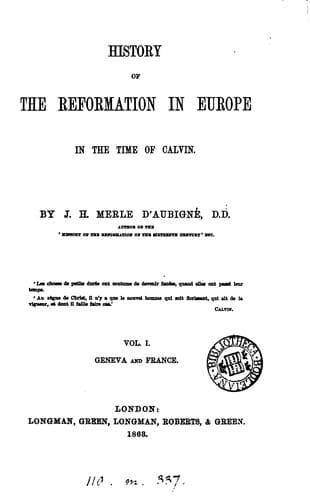
History of the Reformation in Europe in the Time of Calvin, Vol. 6 (of 8)Merle d'Aubigné, J. H. (Jean Henri)
History
History of the Reformation in Europe in the Time of Calvin, Vol. 6 (of 8)
Merle d'Aubigné, J. H. (Jean Henri)
Reformation
It was now November 2 or 3. He immediately convoked a council at
Holyrood palace. But in his rage against the nobles, he summoned only
the bishops, the priests, and their partisans; all those who made a
trade of pandering to the passions of the prince and who had no other
aim but to secure the triumph of the clergy. When they saw the king’s
discouragement, and his anger against the nobles, they persuaded
themselves that the moment was come for them to make an end of their
enemies. That, they thought, would not be very difficult. These men,
branded by public opinion, did not care to furnish evidence in support
of their denunciations. The only trouble they took was to deprive
the innocent of all means of clearing themselves. They thought that
it would for the moment suffice them to obtain a hearing, to accuse
some noble of heresy and to call as witnesses certain men of infamous
character in their own pay. With one accord, therefore, they all strove
to inflame the king against the Reformation and its friends. Oliver
Sinclair, among the laymen, distinguished himself in these proceedings,
and among the churchmen, Beatoun. ‘The cardinal and the priests,’ it
was said, ‘cast fagots in the fire with all their force.’[250] They
drew up a list containing the names of all of whom they wished to be
rid. There were the names of about one hundred nobles, among whom were
Lord Hamilton, the first person of the realm after the king, the earls
of Cassilis and Glencairn, the earl Marshal, and other nobles, all well
disposed towards the Word of God.[251] This fact shows what progress
the Reformation had made in Scotland. The majority of these _suspects_,
to be sure, were not decided evangelical Christians, but they had
leanings that way. Once already James had refused to accept such a
list. But the case was different now, and he accepted it at once, and
expressed to the prelates his regret that he had so long set their
counsels aside. ‘I see clearly at this moment that you are right,’
he said; ‘the nobles neither desire my honor nor my continuance; for
they would not ride a mile for my pleasure to follow enemies. Will
ye therefore find me the means that I may have raid made in England
without their knowledge and consent, that may be known to be my own
raid, and I shall bind me to your counsel forever.’
[Sidenote: A PROSCRIPTION LIST.]
Public-domain text, read in full here on John Shaqi.
Reviews
Reviews
No reviews yet
Be the first to share your thoughts on this work.
Elsewhere in the archive
Join the Discussion
Join the discussion
Sign in to leave a comment or review.
Sign InorCreate an account