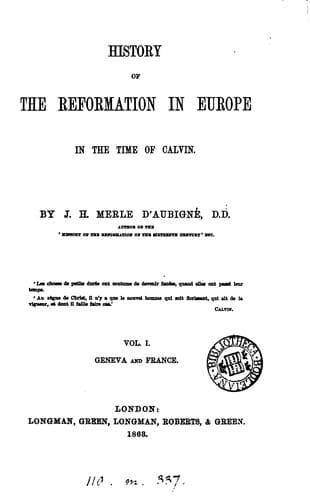
History of the Reformation in Europe in the Time of Calvin, Vol. 6 (of 8)Merle d'Aubigné, J. H. (Jean Henri)
History
History of the Reformation in Europe in the Time of Calvin, Vol. 6 (of 8)
Merle d'Aubigné, J. H. (Jean Henri)
Reformation
Henry published a manifesto in which he declared that his nephew had
been the aggressor. He claimed for the Tudors the crown of the Stuarts.
He resented as bitterly as ever the wound received at York; and the
vengeance which he reckoned on taking was to be cruel, memorable,
and revolutionary. The energy of the uncle was as conspicuous as
the feebleness of the nephew; and when James wrote again with all
_naïveté_, ‘I love you,’ Henry replied savagely, ‘I hate you.’
Norfolk, impatient to avenge the retreat from Halidon, determined to
make an inroad into Scotland before the whole of the army was mustered.
He therefore marched from Berwick, at the northeastern extremity of
England, ravaged the country districts, took several unimportant
places, got himself into various scrapes, and announced that he should
immediately appear at Edinburgh. But within eight or ten days after
passing the Borders he withdrew. He had merely paid an unceremonious
visit, preliminary to one official and in state.
[Sidenote: MUTINY OF THE SCOTS.]
Meanwhile James was putting himself into a position to receive that
visit gallantly, and was assembling his army before Edinburgh. He had
there about twenty thousand men, besides ten thousand more on the
frontier, under the command of the earl of Huntley. But dissension
prevailed in his camp. There were some who cared little for the old
doctrine, but who were eager above everything to break the iron yoke
of the cardinal. Others there were, attached to the Douglases and the
Anguses, who were in the English army, and who had no mind to fight
against them. Others, again, feeling the inferiority of the Scottish
army, steadily insisted that they ought to remain strictly on the
defensive. On a sudden, the Scots encamped at Fala learnt that for want
of supplies the English were retreating on the Tweed. James, who was
easily excited, immediately called together his lords, and exclaimed,
‘Forward! follow me into England!’ His words were received in a gloomy
silence. ‘We are ready, sire,’ said some of the lords to him, ‘to risk
life and whatsoever we have to defend your person and your realm,
but we do not see any sufficient reason for invading England. Our
provisions are spent, our horses wearied; and as for ourselves, we
have so long been absent from our homes, that we think it high time to
return.’
James dissembled his chagrin, and even assumed an air of approval
of the discretion of his lords. But he trembled to see his kingly
authority trampled under foot by his subjects. He was plainly master
no longer. His subservience to the priests had ruined him. The nobles
and the common soldiers, instead of falling upon the English, returned
every man to his own home, and the king, abandoned and left almost
alone, consumed by the profound vexation which was gradually wearing
him away, returned mournfully to Edinburgh.
Public-domain text, read in full here on John Shaqi.
Reviews
Reviews
No reviews yet
Be the first to share your thoughts on this work.
Elsewhere in the archive
Join the Discussion
Join the discussion
Sign in to leave a comment or review.
Sign InorCreate an account