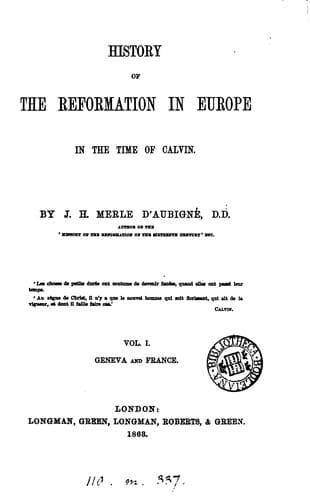
History of the Reformation in Europe in the Time of Calvin, Vol. 6 (of 8)Merle d'Aubigné, J. H. (Jean Henri)
History
History of the Reformation in Europe in the Time of Calvin, Vol. 6 (of 8)
Merle d'Aubigné, J. H. (Jean Henri)
Reformation
Everything about this expedition was indeed extraordinary, and even the
Scots themselves did not know who was in command. Lord Maxwell, warden
of the western marches, was present, and to him that office naturally
belonged; but neither he nor the troops knew anything at all about the
matter. At ten o’clock an unexpected event occurred. The Scots finding
themselves on English ground at Solway, the trumpets were sounded,
the army halted, and the royal flag was displayed and floated in the
midst of them. The wretched Oliver Sinclair mounted on a kind of shield
formed by lances which rested on the shoulders of some of the soldiers.
He presented letters which had been sent him by the king. This prince,
in the belief that this worthless courtier was a great captain, had
named him commander-in-chief. These letters were read to the army, and
the favorite had himself proclaimed lieutenant-general, with orders to
render obedience to him as to the king himself. By what the courtiers
said, to put Sinclair at the head of the army was to make victory
certain. James would not rely upon any of his nobles. Not one of them
was to have the glory of the expedition; it was to be the achievement
of James, to whom the command belonged. Maxwell was present at that
ceremony, seeing everything, hearing everything, and he was astounded
at it, ‘but he thought more than he spoke.’[254] Other lords who were
present did the same. No sooner had the proclamation been read than
murmurs, discouragement, and disorder spread through the army. At the
same time the English took up arms in all haste, ten in one company,
twenty in another. Carlisle closed its gates, and shortly after about
five hundred horsemen appeared on the neighboring heights for the
purpose of reconnoitring the Scottish force.[255] The Scots took these
horsemen for the advance guard of the army of the duke of Norfolk, and
being seized with a panic terror, many of them broke from the ranks.
Some wanted to fight, others wanted to fly. Everything was disorder and
confusion. The troops disbanded and took to flight in all directions.
Lord Maxwell, who had foreseen from the first moment the end of this
mad business, alighted from his horse and spoke to some friends. ‘To
horse and fly,’ they said to him. ‘Nay,’ replied he, ‘I will rather
abide here the chance that it shall please God to send me than to go
home and then be hanged.’[256] The Scots, both horse and foot, threw
away their arms and ran with all their might. A great number of them
were taken prisoners by the soldiers of Henry VIII., and some were
captured by Scottish adventurers and sold to the English.[257] To such
a degree had James’s soldiers lost heart, that those who did not fall
into the hands of men rushed into houses and surrendered themselves
to women.[258] The water had to be recrossed: the tide was high, the
river deep. Many were drowned, and a good number of those who escaped
the river perished in the marshes. Oliver Sinclair, who was ‘fleeing
Public-domain text, read in full here on John Shaqi.
Reviews
Reviews
No reviews yet
Be the first to share your thoughts on this work.
Elsewhere in the archive
Join the Discussion
Join the discussion
Sign in to leave a comment or review.
Sign InorCreate an account