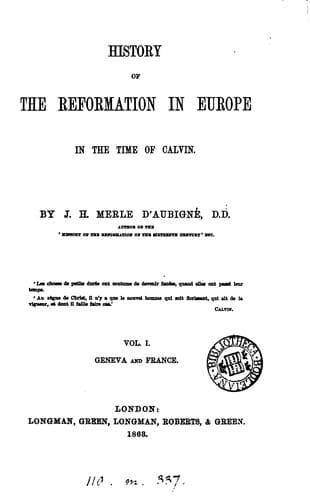
History of the Reformation in Europe in the Time of Calvin, Vol. 6 (of 8)Merle d'Aubigné, J. H. (Jean Henri)
History
History of the Reformation in Europe in the Time of Calvin, Vol. 6 (of 8)
Merle d'Aubigné, J. H. (Jean Henri)
Reformation
full manfully,’[259] was captured without having struck a single
blow. The most distinguished among the Scottish nobles, the earls of
Cassilis and Glencairn, the Lords Somerville, Grey, and Oliphant, were
seen laying down their arms. Maxwell found thus the fate which he had
desired. These lords and gentlemen were sent to London and committed
to the Tower. Two days after, Henry commanded that they should pass
through the streets of London on foot, exposed thus as a spectacle to
the populace,[260] like the captives who adorned the triumphs of Roman
generals. When they arrived at the palace, they were received there by
the Lord Chancellor, who addressed to them severe rebukes, accused them
of having violated the faith of treaties, and extolled the goodness and
clemency of Henry VIII., who assigned them various houses for their
abode.
[Sidenote: MURDER OF AN ENGLISH ENVOY.]
During the battle, if such a word is to be used, James, who took good
care to keep out of it, was concealed in his castle at Lochmaben,
northeast of Dumfries.[261] There he was awaiting the issue of that
famous expedition which was to be his title to glory. He had made
sure of taking at the first blow the town of Carlisle, situated at
a distance of some miles from the frontier, and formerly one of the
principal military posts of the Romans, at which the wall of Hadrian
terminated, and which had been more than once besieged and taken.
Thence he hoped to pass on and reach York, and pay an _armed_ visit
to his dear uncle there. He was expecting the tidings of his triumph,
when some of the fugitives made known to him the total rout of his
army. Overwhelmed with sudden fear and astonishment, he could hardly
utter a word. It was night when he heard of his defeat, and not daring
to venture before daylight into unknown, untrodden ways, he retired to
bed, but without finding the least repose. His distress was unbounded.
He experienced the most acute pangs, could hardly breathe, and only
uttered some vague cries. The manner in which his unworthy favorite
had deceived his expectation, his defeat and flight, disturbed him as
much as the victory of the English. He got up, paced up and down in
his chamber, uttered lamentations, and cried out--‘Oh, fled Oliver? Is
Oliver taken? Oh, fled Oliver?’[262] He was attacked with a kind of
catalepsy. The constant contemplation of that extraordinary defeat and
of the conduct of that despicable man on whom he had rested his hopes
had in some degree suspended sensation in him, and he lay as in a long
and painful trance until his death, continually repeating, ‘Oh, fled
Oliver?’
Public-domain text, read in full here on John Shaqi.
Reviews
Reviews
No reviews yet
Be the first to share your thoughts on this work.
Elsewhere in the archive
Join the Discussion
Join the discussion
Sign in to leave a comment or review.
Sign InorCreate an account