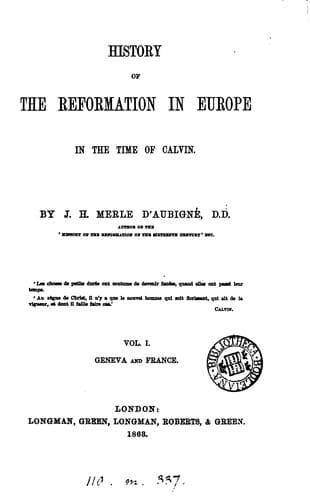
History of the Reformation in Europe in the Time of Calvin, Vol. 6 (of 8)Merle d'Aubigné, J. H. (Jean Henri)
History
History of the Reformation in Europe in the Time of Calvin, Vol. 6 (of 8)
Merle d'Aubigné, J. H. (Jean Henri)
Reformation
James was buried at Holyrood January 8, and the cardinal who had driven
him along that fatal path in which he was to meet death presided at the
ceremony. This prince, thus taken away in the flower of his age, died
not so much of disease as of a broken heart.[265] ‘The sorrow of the
world worketh death.’ He had understanding, but it was uncultivated; he
was moderate in respect to the pleasures of the table, but he had been
thrown in his youth into other irregularities, from which he never got
free. He might be seen in the bitterest winter weather, on horseback
night and day, endeavoring to surprise the freebooters in their
retreats; and poor men had always easy access to him. But for want of
thoughtfulness and solid principles he was incessantly tossed to and
fro between the nobles and the priests, and whichever of these two was
the most adroit easily took the upper hand. He sinned much, but perhaps
he was still more ‘sinned against.’
CHAPTER XII.
REGENCY OF THE EARL OF ARRAN.--IMPRISONMENT OF BEATOUN.--TREATY OF
PEACE WITH ENGLAND.
(1542-MARCH 1543.)
[Sidenote: GENERAL DEPRESSION.]
The political and religious events in the midst of which James V. had
been taken from Scotland were of so grave a character that the wisest
heads felt some alarm, and expected to see a storm break forth such as
no one had ever seen the like.[266] An unexpected blow, considering the
youthful years of the prince, had fallen on the nation. With eyes fixed
on the future, nobles and people talked together of their fears and the
faintness of their hopes.[267] In the Lowlands, in the heart of the
Highlands, at Edinburgh, at Glasgow, at Stirling, and in other towns
of Scotland, men with pale faces and a restless air were questioning
one another in distress of mind about the fate in reserve for their
country. The shameful defeat at Solway, which had given the king his
death-blow, had filled the people with mourning and dread. The most
illustrious lords of Scotland, taken prisoners by the English, had been
exposed to the gaze of the citizens of London. Those who still remained
in Scotland were divided by implacable hatred, and by religious views
diametrically opposed to each other; and it was anticipated that
dissensions long suppressed by the fear of the king would now burst
forth. The cardinal and the bishops, giving themselves up without
restraint to their passion for dominion, were going to take advantage
of the death of James to bring the people into subjection. Henry VIII.,
glorying in the unexpected victory which he had just won, did not fail,
now that his nephew was no more, to turn to account (and in what a
fashion!) his pretensions to Scotland. For maintaining order in the
country there was a queen eight days old. The next heir to the crown
after her, Hamilton, earl of Arran, was not fitted by his virtues, or
his intelligence, or his courage to rule the people.
Public-domain text, read in full here on John Shaqi.
Reviews
Reviews
No reviews yet
Be the first to share your thoughts on this work.
Elsewhere in the archive
Join the Discussion
Join the discussion
Sign in to leave a comment or review.
Sign InorCreate an account