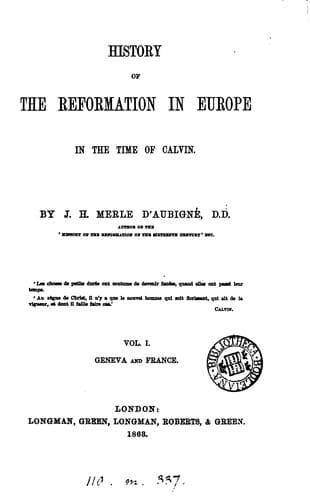
History of the Reformation in Europe in the Time of Calvin, Vol. 6 (of 8)Merle d'Aubigné, J. H. (Jean Henri)
History
History of the Reformation in Europe in the Time of Calvin, Vol. 6 (of 8)
Merle d'Aubigné, J. H. (Jean Henri)
Reformation
Arran, it is true, was not distinguished for his virtues nor for his
intelligence, but he was very generally liked, as weak men often are.
‘The earl of Arran,’ wrote Lord Lisle to Henry VIII., ‘is himself a
good soft God’s man, and loveth well to look on the Scripture, but he
hath many that ruleth about him of his kin which be shrewd and evil
men.’[270] Never had any regent been received with so much liking and
hope, and this was the case especially because people were glad to be
delivered from the cardinal. It was thought that he would reform all
that went wrong in the church or state, and his first acts corresponded
with this hope.[271] That Arran should thus get possession of power
was astonishing, for he was as weak as Beatoun was strong, and the
weakest, they say, always goes to the wall. In this case the reverse
happened. But many people thought that the arrangement would be only
temporary. Arran was the earthen pot of the fable, Beatoun the iron
pot, and it was not difficult to foresee which of the two would break
the other. It was not long before Arran gave a proof of his too easy
temper. Instead of adopting measures for withdrawing the realm from
the influence of Beatoun, as soon as the latter claimed to be made
chancellor of Scotland, Arran committed that office to his hands, in
order to alleviate the disgrace to which the assembly of the nobles had
just subjected him.[272] The ambitious cardinal, however, did not long
keep that post of influence.
Many eminent and pious men supported the cause of the earl of Arran.
One of his first acts was to appoint as his chaplains, on the
recommendation of those supporters, two ministers who preached the
pure Gospel. A former Dominican, Thomas Guillaume (or Williams), who
had been very eminent in his order, having been converted by the Word
of God, had thrown off his cowl. He was called to preach at Edinburgh.
The soundness of his judgment, the purity of his doctrine, the force
of his eloquence, and the clearness of his exposition of Scripture,
together with a certain moderation in controversy, attracted a crowd
to his preaching. The regent associated with him another evangelical
minister, John Rough. He had entered a convent at seventeen years of
age, had twice visited Rome, and having been painfully shocked by what
he had seen there, he had embraced the Reformation. Less of a scholar
than Guillaume, he was more simple-minded, and more ardent against
superstition and impiety, and against the authority of the pope. Arran,
urged on by his evangelical friends, sent his faithful ministers into
various parts of the kingdom. Among their numerous hearers was Knox,
and it was while listening to Guillaume that the great reformer began
to be acquainted with the beauty of evangelical truth.[273]
Public-domain text, read in full here on John Shaqi.
Reviews
Reviews
No reviews yet
Be the first to share your thoughts on this work.
Elsewhere in the archive
Join the Discussion
Join the discussion
Sign in to leave a comment or review.
Sign InorCreate an account