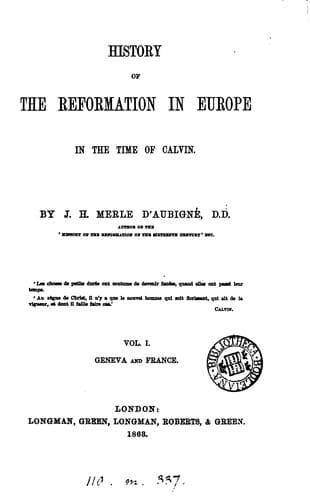
History of the Reformation in Europe in the Time of Calvin, Vol. 6 (of 8)Merle d'Aubigné, J. H. (Jean Henri)
History
History of the Reformation in Europe in the Time of Calvin, Vol. 6 (of 8)
Merle d'Aubigné, J. H. (Jean Henri)
Reformation
But while those who had their hearts opened to the truth received with
joy the words of the two chaplains, the monks, the priests, and all
the friends of the papacy attacked them vehemently. ‘Heresy! heresy!’
cried a Franciscan named Scot; ‘Guillaume and Rough will carry the
governor unto the devil.’ And all the monks and sacristans took up
the cry, ‘Heresy!’ A man named Watson, of the household of the bishop
of Dunkeld, composed a satirical ballad against the chaplains and the
regent which had a great vogue. The cardinal on his part was moving
heaven and earth, and worried Arran to silence the two preachers. ‘All
these men,’ says Knox, ‘roupit [croaked] as they had been ravens, yea
rather they yelled and roared as devils in hell.’ For the moment, these
cries were futile. The divine Word prevailed.
[Sidenote: PROPOSAL OF HENRY VIII.]
While these things were passing in Scotland, Henry VIII. was fully
occupied in England. The death of James had startled him, and his
first thought had been that the succession must fall to him. He would
unite the two kingdoms, and it would be an immense advantage to Great
Britain to be all under one government, and that his own. To this end a
marriage should be concluded between his son Edward, aged five years,
and the young Queen of Scotland, aged a few days. He lost no time
in sending for the most notable of the Scottish captives to Hampton
Court palace, where he was then residing. The earls of Cassilis and
Glencairn, and the Lords Maxwell, Fleming, and Grey, men who only a
few days before had been made a spectacle to the populace of London,
appeared before him. He stated to them his project. ‘God,’ said he,
‘now offers you a most favorable occasion for establishing agreement
and peace in Great Britain. Let a contract be concluded between your
queen and my son. I offer to set you at liberty if you will pledge
yourselves to do all you can to get the consent of the regent and of
the other nobles of Scotland to this marriage.’ The project highly
pleased the lords, for they saw in it a certain means of obtaining not
only liberty for themselves, but a lasting peace for their country.
Agreement was made that the Queen Mary should marry the prince Edward
when she was ten years old. After this conference the noble prisoners
set out, December 29, on their way to Scotland, to secure the success
of their scheme.
Public-domain text, read in full here on John Shaqi.
Reviews
Reviews
No reviews yet
Be the first to share your thoughts on this work.
Elsewhere in the archive
Join the Discussion
Join the discussion
Sign in to leave a comment or review.
Sign InorCreate an account