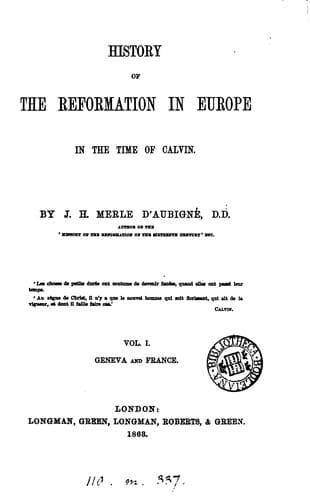
History of the Reformation in Europe in the Time of Calvin, Vol. 6 (of 8)Merle d'Aubigné, J. H. (Jean Henri)
History
History of the Reformation in Europe in the Time of Calvin, Vol. 6 (of 8)
Merle d'Aubigné, J. H. (Jean Henri)
Reformation
Lord Maxwell, whom the folly of James V. had deprived of the command in
the affair at Solway, was generally known as ‘a man of good intentions
with respect to the Word of God.’ He had not openly professed the
evangelical doctrine so long as the cardinal was in possession of the
supreme power; but his sojourn in England, though short, had induced
him to take a more decisive course. He rose and introduced a bill
providing ‘that all the subjects of the kingdom might read the Holy
Scriptures in their mother-tongue.’ The debate began immediately.
Dunbar, archbishop of Glasgow, who since the imprisonment of the
cardinal had become chancellor of the realm, declared that he would
oppose the motion in his own name and in the name of all the prelates,
at least until the period when a provincial council of all the clergy
of Scotland should have decided the question. ‘Wherefore,’ answered
the friends of the Scriptures, ‘should it not be lawful to men that
understood no Latin, to use this word of their salvation in the tongue
they understand, as it was for Latin men to have it in Latin, Grecians
and Hebrews to have it in their tongues.’ ‘The kirk,’ replied the
priests, ‘had forbidden all kind of tongues but these three.’ ‘When was
that inhibition given?’ retorted the friends of the Gospel. ‘Christ
has commanded his word to be preached to all nations. Now if it ought
to be preached to all nations, it must be preached in the tongue they
understand. Now if it be lawful to preach it in all tongues, why shall
it not be lawful to read it and to hear it read in all tongues? To the
end that the people may try the spirits according to the commandment of
the apostle.’[283]
[Sidenote: FREEDOM TO READ THE BIBLE.]
The prelates finding themselves beaten admitted that the Holy
Scripture might indeed be read in the vulgar tongue, provided that the
translation were true. Some of the members of the assembly then handed
to the priests some copies of the Holy Scriptures which they drew from
their pockets, and begged them to point out any faults they could find
in them. The prelates, in great embarrassment, began to make search,
turned over the leaves of the book, opening it at the beginning, at the
end, and in all parts, taking infinite pains to find some mistake. But
nothing could be found. At last, ‘Here,’ said one of them, ‘here is
a passage to be reprehended; love is put in the place of _charity_.’
‘What difference is there,’ it was replied, ‘betwixt the one and the
other? It seems you do not understand the Greek term ἀγάπη.’ Before the
Greek word the priests stood dumb.[284]
Public-domain text, read in full here on John Shaqi.
Reviews
Reviews
No reviews yet
Be the first to share your thoughts on this work.
Elsewhere in the archive
Join the Discussion
Join the discussion
Sign in to leave a comment or review.
Sign InorCreate an account