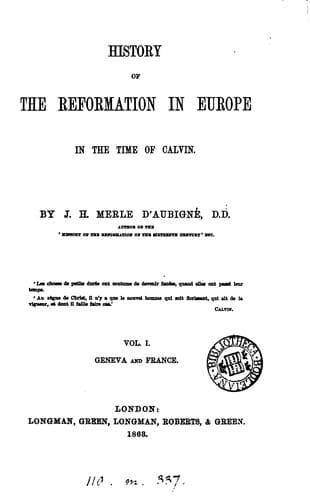
History of the Reformation in Europe in the Time of Calvin, Vol. 6 (of 8)Merle d'Aubigné, J. H. (Jean Henri)
History
History of the Reformation in Europe in the Time of Calvin, Vol. 6 (of 8)
Merle d'Aubigné, J. H. (Jean Henri)
Reformation
The Scottish Parliament was to open at Easter, and the moment
was approaching. Instead of one there would be (so to speak) two
parliaments. The party of the opposition, the earls of Huntley, Argyle,
Murray, and Bothwell, a very great number of barons, knights, bishops,
and abbots, met at Perth a week before the day of convocation, and
having drawn up certain articles, they sent them to the regent and his
council by the hands of the bishop of Orkney and Sir John Campbell,
uncle to the earl of Argyle. Let the cardinal, they said, be set at
liberty; let the New Testament be interdicted; let the regent confer
with us on all affairs of the realm, and let other ambassadors be
sent to the King of England, charged with a quite different mission
from that which has been determined on. The regent by the advice of
his council declined to accede to ‘demands so unreasonable.’ The next
step, immediately taken, was to send a herald-at-arms to Perth, to
summon the lords who were there to Edinburgh, under penalty of treason,
to discharge their duties. This citation took effect. The earl of
Murray, the bishops, and abbots arrived on the eve of the opening of
parliament. The other lords presented themselves later. Argyle alone
remained on his estates. His two uncles, however, offered excuse for
him, on the ground of ill health.[281]
Parliament opened on Monday, March 12. The assembly was numerous,
for the gravity of the occasion was universally understood. ‘This
parliament,’ said the earl of Angus, ‘is the most _substantial_ that
was ever seen in Scotland; the three estates are present in great
force, and the multitude of on-lookers is so great that no more
could find lodging in the two towns of Edinburgh and Leith.’ The
first resolution of this important assembly approved the marriage of
prince Edward and the little Queen Mary, and empowered ambassadors to
negotiate it with England.[282] The second resolution (Tuesday) was the
confirmation of the earl of Arran in the office of regent. On Wednesday
the earl of Angus and his brother were reinstated in the honors and the
estates of which they had been deprived during their fifteen years’
exile. On Thursday the most important of all the resolutions of this
body was to be presented and debated.
Public-domain text, read in full here on John Shaqi.
Reviews
Reviews
No reviews yet
Be the first to share your thoughts on this work.
Elsewhere in the archive
Join the Discussion
Join the discussion
Sign in to leave a comment or review.
Sign InorCreate an account