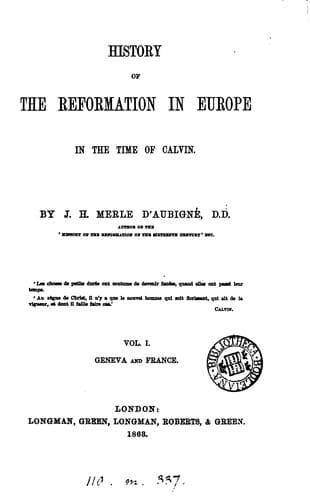
History of the Reformation in Europe in the Time of Calvin, Vol. 6 (of 8)Merle d'Aubigné, J. H. (Jean Henri)
History
History of the Reformation in Europe in the Time of Calvin, Vol. 6 (of 8)
Merle d'Aubigné, J. H. (Jean Henri)
Reformation
As Scotland was under obligation to give hostages to England as
security for the execution of the treaties, the cardinal set himself
strenuously against the measure, not only with those of his own
faction, but also with those of the other side. He was prodigal of
promises to the relations and the friends of the intended hostages,
in the hope of inducing them to oppose their delivery to England. The
same influences were brought to bear on the regent. On the day fixed
for giving up the lords to the English ambassador, the latter went
to the regent, and after making complaint of the insults to which
he was exposed, demanded the hostages. The regent promised that the
perpetrators of the outrages of which Sadler complained should be
punished. ‘As for the hostages,’ he added, ‘the authority with which I
am invested is of such a nature that, while I have rights as against
the queen’s subjects, they also have their rights as against me. You
are yourself a witness of the immense agitation stirred up by the
cardinal.[300] All my plans are upset, and, carried away by the force
of popular passion, I can no longer answer for anything.’[301] Arran
was indeed wanting in the strength to stand against such a storm as
was conjured up by the cardinal. Weakminded himself, he bent before
the violence of those who had powerful convictions. Sadler, indignant
at his refusal, called upon the Scots who had been captives in England
to return to their confinement, as they had pledged themselves to do
in case the treaty should be violated. Kennedy, earl of Cassilis, was
the only one who kept his word. He set out for London, in spite of the
pressing entreaties of his own circle.[302] Henry, touched by this
act of good faith, generously sent him back to Scotland with his two
brothers who had remained as hostages.
The clerical reaction was steadily gathering fresh force. In pursuance
of the colloquy of July 6, the nobles hostile to the regent assembled
some troops; and on July 21 they arrived, at the head of ten thousand
men, at Leith, the port of Edinburgh. At the same moment Arran, the
earl of Angus, Lord Maxwell, and their friends were at Edinburgh, at
the head of their armed force. There was equal animation on both sides.
They might have been likened to two electric clouds, whose lightning
was ready to burst forth with violence. However, the two opposed bodies
of troops remained motionless for five or six days. ‘What will be the
end of this,’ wrote Sadler to Lord Parr, ‘I cannot tell; but my opinion
is that they will not fight for all their bragges.’[303] In fact, they
did not fight.
[Sidenote: IRRESOLUTION OF ARRAN.]
Public-domain text, read in full here on John Shaqi.
Reviews
Reviews
No reviews yet
Be the first to share your thoughts on this work.
Elsewhere in the archive
Join the Discussion
Join the discussion
Sign in to leave a comment or review.
Sign InorCreate an account