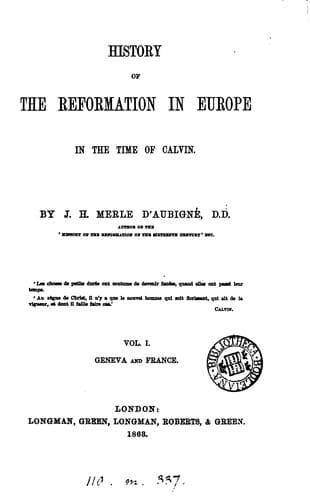
History of the Reformation in Europe in the Time of Calvin, Vol. 6 (of 8)Merle d'Aubigné, J. H. (Jean Henri)
History
History of the Reformation in Europe in the Time of Calvin, Vol. 6 (of 8)
Merle d'Aubigné, J. H. (Jean Henri)
Reformation
The two queens were at Linlithgow palace, in which the young Mary was
born. The regent and the cardinal each gave out that the queens were
on his side, but all the sympathies of the queen-mother were with the
cardinal. The latter, accompanied by the earls of Argyle, Huntley,
and Bothwell, and by many bishops, went to Linlithgow. Supposing that
the princesses were not safe there, he persuaded them to go with him
to Stirling, which they did. These lords talked without reserve among
themselves, and with the queen, of deposing the regent, on the ground
of disobedience to their holy mother the Church. This greatly alarmed
Arran, who at that same time was persecuted by the abbot of Paisley,
his natural brother. ‘Consider,’ said the latter, ‘the danger to
which you expose yourself by allowing the authority of the pope to be
impaired. It is the authority on which your own rests.’ As Arran was in
dread of the anger of Henry VIII., the abbot exalted to the utmost the
power of the King of France, and the great advantages of an alliance
with him. But above everything else he insisted on the obligation of
making peace with the Church, ‘out of whose pale,’ he repeated, ‘there
is no salvation.’ The poor regent, weak, inconstant, and not at all
grounded in the faith of the Gospel, halted between the wish to follow
the advice of his brother and the shame involved in abandoning his
party and giving the precedence to the cardinal. He wavered between
the pope and the Gospel, between France and England. His irresolution
was torture to him; he endured bitter pangs. The abbot never wearied
of repeating the question, ‘What will ye do? will you then destroy
yourself and your house for ever?’[304] He hesitated no longer. Beaten
on all sides by contending waves; conscious that his forces were
inferior to those of his adversaries; hemmed in by the snares of the
cardinal, who chose rather to gain him by terror than to subdue him
by arms; abandoned by many of the nobles; no longer in favor with the
people, who were offended by his weakness; lowered in the esteem of
his own friends, and disgraced in the eyes of the English, the unhappy
man at last took the fatal leap. Nine days after the ratification of
the alliance with England, and only six days after he had published
a proclamation against the cardinal, Arran secretly stole away from
Holyrood palace, betook himself to Stirling on September 3, and threw
himself into the arms of his cousin Beatoun.
Public-domain text, read in full here on John Shaqi.
Reviews
Reviews
No reviews yet
Be the first to share your thoughts on this work.
Elsewhere in the archive
Join the Discussion
Join the discussion
Sign in to leave a comment or review.
Sign InorCreate an account