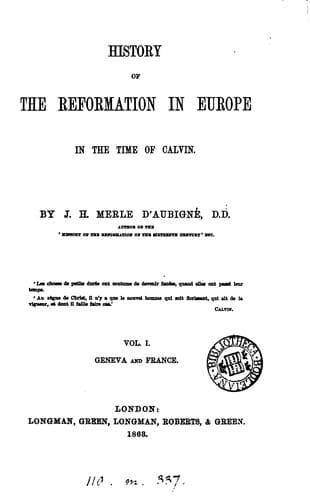
History of the Reformation in Europe in the Time of Calvin, Vol. 6 (of 8)Merle d'Aubigné, J. H. (Jean Henri)
History
History of the Reformation in Europe in the Time of Calvin, Vol. 6 (of 8)
Merle d'Aubigné, J. H. (Jean Henri)
Reformation
When the cardinal came out of prison, his eyes had fallen on two men
who stood in his way. One of these was the regent, and he had got rid
of him by becoming his master. The other was the earl of Lennox, a man
formidable by his rank and his pretensions, who had even supposed it
possible that he might marry the queen-mother. But Mary of Guise, like
all her kindred, was a fanatical devotee of Rome, and at the instance
of the cardinal she prayed the King of France to recall Lennox on any
specious pretext, adding that his residence in Scotland might lead to
a disturbance of peace. Lennox saw that they were trifling with him.
He was quite as versatile as Arran but more capable, and seeing that
he had lost the favor of France, he offered his services to the King
of England, who eagerly accepted them. Lennox was then looked upon as
the head of Scottish Protestantism. The two foremost lords of Scotland
had performed a feat of what is vulgarly called _chassé-croisée_. The
leader of the Protestants had become a papist, and the man of the
court of Francis I. had turned Protestant. Instead of the daughter of
the Guises, he married Lady Margaret Douglas, a niece of Henry VIII.
That is how men of the world manage matters. Evangelical religion
had not lost much in losing Arran. Neither had it gained more by
acquiring Lennox. These men were only moved by political interests, and
Scottish Protestantism more than any other was to reject these shameful
combinations of Christ and Baal, and was to have one king alone, Jesus
Christ.
The cardinal, victorious along the whole line, set himself immediately
to the work which he had most at heart,--to crush the Reformation. The
law which authorized the reading of Holy Scripture had borne its fruit,
and ‘in sundry parts of Scotland,’ says the chronicler, ‘thereby were
opened the eyes of the elect of God to see the truth and abhor the
papistical abominations.’[310] This abhorrence might possibly drive
them to deplorable excesses, an instance of which we are soon to see.
There were at Perth, on the left bank of the pleasant river Tay, some
friends of the Reformation. Endowed for the most part with genuine
piety, they held meetings, read the Holy Scriptures together, searched
out their meaning, and gave or listened to the exposition of them.[311]
Public-domain text, read in full here on John Shaqi.
Reviews
Reviews
No reviews yet
Be the first to share your thoughts on this work.
Elsewhere in the archive
Join the Discussion
Join the discussion
Sign in to leave a comment or review.
Sign InorCreate an account