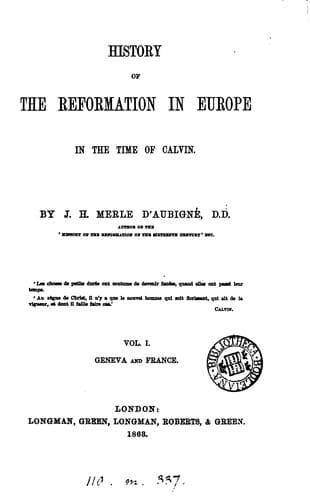
History of the Reformation in Europe in the Time of Calvin, Vol. 6 (of 8)Merle d'Aubigné, J. H. (Jean Henri)
History
History of the Reformation in Europe in the Time of Calvin, Vol. 6 (of 8)
Merle d'Aubigné, J. H. (Jean Henri)
Reformation
They had also at times simple social meals together. Certain priests
of the town, with whom they were connected, and whose character
they esteemed without sharing their opinions, were invited to these
gatherings. The churchmen ate, drank, and talked with them, and thought
themselves fortunate to be invited to these honest men’s houses.[312]
This circumstance shows a large-heartedness among these Christian folk
of Perth, which could see and appreciate whatever good qualities their
adversaries possessed. They did not, however, tie themselves down
to the Roman rules about meat-days and fish-days, rules from which
exemption may be had for a little money: and one Friday it happened
that a goose appeared on their table.
Three of these people, Robert Lamb, William Anderson, and James
Raveleson, daring characters and given to raillery, were among those
who were taken up with Reform on its negative side. They were disgusted
at the abuses of the monastic life, and the Franciscans most of all
offended them. The sight of one of these mendicant friars in the
street, with his brown frock, his girdle of cord, his cowl, and his
bare feet, excited in them the keenest aversion. ‘These monks,’ as has
been said by a very distinguished Catholic priest, ‘feign chastity, but
they know what voluptuousness is, and they often outdo men of the world
in luxurious indulgence.’[313] And yet these monks pretend that all
that is needed for salvation is to put on a frock of their order at the
moment of death. In the judgment of Anderson and of his two friends,
the founder of that order, who was nevertheless a better man than
most of his successors, must have been the devil himself. They took
therefore an image of Francis of Assisi, nailed rams’ horns on the head
and hung a cow’s tail behind, and having thus given to it the semblance
of a demon, they hung it. The Scots are not jesters by nature. They are
on the contrary earnest and energetic towards those whom they oppose;
and this blameworthy execution was carried out by these three men with
imperturbable gravity.[314]
[Sidenote: RAVELESON AND LAMB.]
Public-domain text, read in full here on John Shaqi.
Reviews
Reviews
No reviews yet
Be the first to share your thoughts on this work.
Elsewhere in the archive
Join the Discussion
Join the discussion
Sign in to leave a comment or review.
Sign InorCreate an account