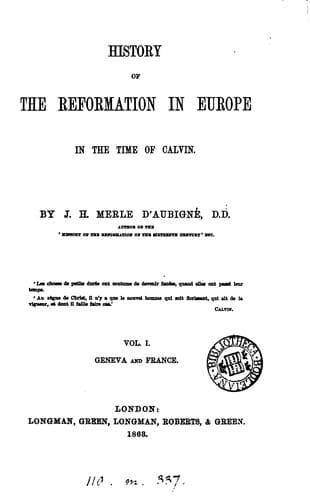
History of the Reformation in Europe in the Time of Calvin, Vol. 6 (of 8)Merle d'Aubigné, J. H. (Jean Henri)
History
History of the Reformation in Europe in the Time of Calvin, Vol. 6 (of 8)
Merle d'Aubigné, J. H. (Jean Henri)
Reformation
Melville forgot that there was no city of refuge for Beatoun. Regarding
him as a murderer, and not supposing that by killing him he did himself
incur the guilt of murder, he presented to him the point of his sword,
and said gravely to him, ‘Repent thee of thine former wicked life, but
especially of the shedding of the blood of that notable instrument of
God, Mr. George Wishart; which albeit the flame of fire consumed before
men, yet cries it a vengeance upon thee, and we from God are sent to
revenge it. Here before my God I protest that neither the hatred of thy
person, the love of thy riches, or the fear of any trouble thou couldst
have done to me in particular, moved or moveth me to strike thee.’ And
he struck him with his sword.
The cardinal fell under repeated blows, without a word heard out of his
mouth except these, ‘I am a priest! I am a Priest! Fie, fie! All is
gone!’[366]
It was very soon known all over the city that the castle had been
taken. The friends and the creatures of the cardinal rose very quietly
from their beds, says Buchanan, armed themselves, and presently
appeared in a crowd about the fosse. They shouted with all their might,
uttered threats and insults, and demanded shells and all the necessary
means for making the assault. ‘You are making much noise to little
purpose,’ said those in the castle to them; ‘the best it were to you to
return to your own houses.’
The crowd answered, ‘What have ye done with my lord cardinal? Let us
see my lord cardinal!’--‘The man that you call the cardinal,’ it was
replied, ‘has received his reward, and in his own person will trouble
the world no more.’ But his partisans only cried the louder, ‘We shall
never depart till we see him,’ still persuaded that he was alive. Then
one or two men took up the body, and bearing it to the very window
at which a little while before Beatoun had sat to contemplate with
gladness, and as if in triumph, the execution of the pious Wishart,
exposed it there to the gaze of all.[367] Beatoun’s friends and the
populace, struck with amazement and terror by the unexpected sight, and
remembering Wishart’s prediction, dispersed in gloom and consternation.
The tidings of this murder were speedily spread over all the land, and,
while some angrily denounced it, others welcomed it as an event which
restored their country to liberty. There were indeed some who, like
James Melville, reckoned it a lawful act. But even among the enemies of
the cardinal there were men wise and moderate, who looked on the murder
with horror. It is remarked by one historian that of those who took
part in it few escaped the judgment of God, who punishes transgressors
by smiting them with the same stroke with which they have smitten
others.[368]
Public-domain text, read in full here on John Shaqi.
Reviews
Reviews
No reviews yet
Be the first to share your thoughts on this work.
Elsewhere in the archive
Join the Discussion
Join the discussion
Sign in to leave a comment or review.
Sign InorCreate an account