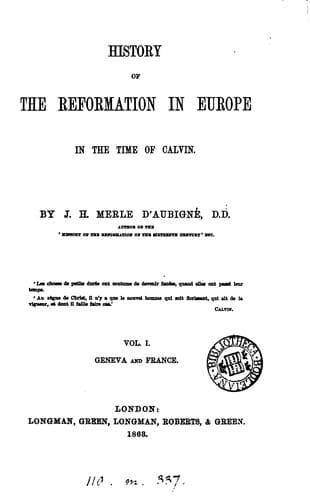
History of the Reformation in Europe in the Time of Calvin, Vol. 6 (of 8)Merle d'Aubigné, J. H. (Jean Henri)
History
History of the Reformation in Europe in the Time of Calvin, Vol. 6 (of 8)
Merle d'Aubigné, J. H. (Jean Henri)
Reformation
The Lesleys and their friends remained masters of the castle, and
they kept with them James, Lord Hamilton, afterwards earl of Arran,
the regent’s eldest son, whom Beatoun had detained as his hostage,
and who now became theirs. One of the conspirators, who believed that
in delivering Scotland from the tyrant they had done a praiseworthy
deed, William Kirkaldy, went to London. He obtained from Henry VIII.,
who considered the taking of the castle and the events which had
accompanied it to be a lawful revolution, a declaration that he was
prepared to take the party under his protection, on condition, however,
that the marriage contract between Edward and Mary should be carried
out. As communication by sea was easy between the castle and London,
English ships conveyed thither all supplies that were needful.
[Sidenote: OPINIONS ON THE MURDER.]
Hamilton, a bastard brother of the regent, was named by him archbishop
of St. Andrews, and was confirmed by Pope Paul III. This energetic
prelate immediately pressed on his brother the duty of besieging the
castle and of punishing all those who had taken it. He was strongly
supported by others. On August 23, 1546, the main body of the army
set out from Edinburgh to form the siege; but at the end of July,
1547,[369] the capture of the fortress being evidently hopeless, terms
were made with the besieged advantageous to them, but which neither
side had any intention of observing. This period forms an important
epoch, and we must suspend for a while the course of our narrative.
We have now traced the history of the ministry and the martyrdom of
Patrick Hamilton and George Wishart. We shall have by-and-by to trace,
_Deo adjuvante_, the mighty action of the third and greatest of the
Scottish reformers, John Knox.
The period, the history of which we have just gone over, was one of
active persecution. It remains for us to recount the events of the
contest with the papacy, into which the Scottish nobility energetically
entered, and the victory of the Reformation. Without entering at
present upon the narrative of facts, we shall cast a glance forward
in order to point out what was to give the victory to evangelical
Christianity. Assuredly it was not such actions as the capture of the
castle and the violent death of the persecutor. Such things are more
likely to ruin a cause than to save it. The Christian life and death
of Wishart contributed far more powerfully than the death of Beatoun
to the advancement of the kingdom of God. The history of the Scottish
Reformation serves to show the untruth of one assertion frequently made
by the enemies of the Reform.
Public-domain text, read in full here on John Shaqi.
Reviews
Reviews
No reviews yet
Be the first to share your thoughts on this work.
Elsewhere in the archive
Join the Discussion
Join the discussion
Sign in to leave a comment or review.
Sign InorCreate an account