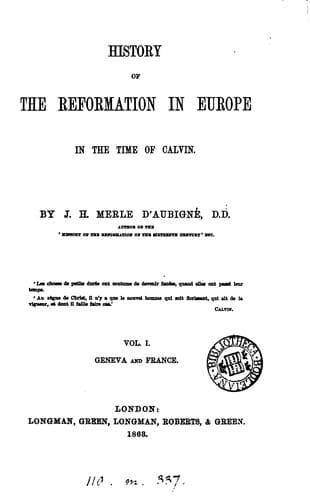
History of the Reformation in Europe in the Time of Calvin, Vol. 6 (of 8)Merle d'Aubigné, J. H. (Jean Henri)
History
History of the Reformation in Europe in the Time of Calvin, Vol. 6 (of 8)
Merle d'Aubigné, J. H. (Jean Henri)
Reformation
It is a grave error to attribute, as some have done, to the Protestant
pastors of Scotland an incomprehensible domination, ‘an authority
nowise inferior to that which they had exercised as Catholic priests,’
and to represent them as ‘the most effectual obstacle to popular
progress.’[372] Nothing has in fact been less like the haughty Catholic
prelates of St. Andrews, Glasgow, and other dioceses, than a Scottish
minister. The Reformation gave to Scotland not only Christian truth,
but religious and political liberty besides. There, as everywhere,
it took from the priesthood its magic and its supremacy, which had
been its two main attributes in the Middle Ages. The ministers, whom
it substituted for the priests, having no longer the marvellous power
of transforming a bit of bread into God the Creator,--these disciples
of Jesus, no longer seated on the despotic throne of the confessional
to give pardon for sins, became simple heralds of the divine Word.
This holy Word has its place in every family and reigns supreme in
the Church. Thus, ministers have ceased to be masters and have become
servants. The real offence of these Scottish pastors, in the sight of
their detractors, is that they have always been a great obstacle, not
to the progress of the people and of civilization, as some have said,
but to the progress of unbelief and materialism. Now these mischievous
doctrines are mortal enemies to the freedom and prosperity of nations.
BOOK XI.
CALVIN, AND THE PRINCIPLES OF HIS REFORM.
CHAPTER I.
CALVIN AT GENEVA AND IN THE PAYS DE VAUD.
(1536.)
For years, and even for centuries, persistent and perilous endeavors
had been made at Geneva for a firm establishment of freedom. We have
already described some of the impressive scenes which marked the
successful close of these efforts at the beginning of the sixteenth
century, the noble principles and the mighty words of the energetic
laborers in this great enterprise.[373] It would certainly be going too
far to consider their labors and the truths which they announced as the
source whence our modern liberties have sprung. But it is impossible to
study the events of that epoch without emotion, or without recognizing
aspirations, principles, sacrifices, and actions worthy of admiration,
which were in fact the first great burst of light, the first noteworthy
manifestation of the politics and the virtues which must determine the
existence and make the prosperity of nations.[374]
Public-domain text, read in full here on John Shaqi.
Reviews
Reviews
No reviews yet
Be the first to share your thoughts on this work.
Elsewhere in the archive
Join the Discussion
Join the discussion
Sign in to leave a comment or review.
Sign InorCreate an account