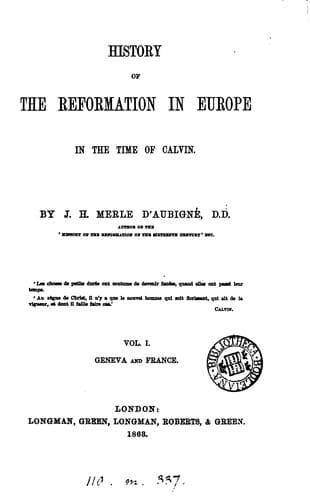
History of the Reformation in Europe in the Time of Calvin, Vol. 6 (of 8)Merle d'Aubigné, J. H. (Jean Henri)
History
History of the Reformation in Europe in the Time of Calvin, Vol. 6 (of 8)
Merle d'Aubigné, J. H. (Jean Henri)
Reformation
According to them, the Reform could triumph only in those countries in
which it had the protection of princes. This is a serious error. It was
not the bloodthirsty Philip II. who established the Reformation in the
United Provinces of the Netherlands. It was neither the feeble James
V. nor the popish Mary Stuart who secured its triumph in Scotland.
That worthy niece of the Guises sought only to crush it. A stronger
arm than theirs fought against those mighty ones and gave the victory
to the weak. The enemies of the Reformation made use in Scotland of
the very weapons which in Italy, in Spain, and elsewhere arrested the
movement of regeneration. The reformers were burnt also in Scotland,
but the Reform arose out of their ashes. It was neither to their
character nor to their strength that the Scots attributed the triumph.
They knew that Jesus is the king of the Church, and that it is he who
saves it. This is the feature which more than any other, as we shall
see, characterized the Scottish Reformation. Andrew Melville said to
James VI., ‘Sire, there are two kings and two kingdoms in Scotland.
There is King James, the head of the state, and there is Jesus Christ
who is head of the Church.’[370] To the king enthroned at Rome, the
Scottish Reformation opposed the king enthroned in heaven, and to him
it attributed the victory.
[Sidenote: PRIEST AND PASTOR.]
But in proclaiming this supreme authority, the reformation in Scotland
also established the duties and the rights of Christians. The charge
of leading the Church in conformity with the law of God was there
intrusted to general assemblies elected by the free choice of a
Christian people.[371] The clergy had ruled in Scotland throughout
the fourteenth and fifteenth centuries, and during the first part of
the sixteenth. The Reformation rescued the country from that clerical
domination, and gave to it the first of all liberties, the freedom of
faith. For centuries three powers had existed there,--the king, the
nobles, and the priests, and the last had kept the upper hand. After
the Reformation, two of these still remained, the king and the nobles;
but the people took the place of the clergy. It was under a popular
form, that of Presbyterianism, that the Church of Scotland constituted
itself. The feudal castles had for some time still a marked influence
on the destinies of the country; but the tide of national and Christian
life was steadily rising all round their walls and soon overflowed the
ancient battlements which crowned the summits of those old fortresses.
Laymen, the deputies of the people, obtained a voice in the presbytery,
in the synod, and in the general assembly. Thus, by successive steps,
the voice of the people became, through the influence of Reform, the
expression of the main force of the country.
Public-domain text, read in full here on John Shaqi.
Reviews
Reviews
No reviews yet
Be the first to share your thoughts on this work.
Elsewhere in the archive
Join the Discussion
Join the discussion
Sign in to leave a comment or review.
Sign InorCreate an account