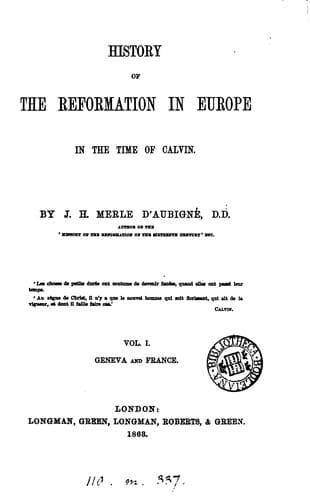
History of the Reformation in Europe in the Time of Calvin, Vol. 6 (of 8)Merle d'Aubigné, J. H. (Jean Henri)
History
History of the Reformation in Europe in the Time of Calvin, Vol. 6 (of 8)
Merle d'Aubigné, J. H. (Jean Henri)
Reformation
A young stranger, a native of Picardie, had lately arrived at Geneva.
It had not occurred to him nor to his friends that he could be the
organ by whose agency and means God would bring about such great ends.
After his arrival Farel still continued to hold the first place in
the city. This young man, John Calvin, was naturally timid, and was
possessed by a dread of publicity which had already shown itself at
Basel and which led him to shun every occasion that would draw public
attention to himself. He was fond of study and of writing: and in that
path he believed that it was appointed for him to contribute to the
diffusion in the world of a truth which was already dearer to him than
life. He purposed to turn to account that one talent in retirement,
without quitting his study. That is what he was then doing at Geneva.
He was steadily engaged in translating into French his ‘_little book_,’
the _Institution Chrétienne_, which he hoped ere long to send to his
friends in France.[375] The letter mentioned in the note shows clearly
that the _Institution Chrétienne_ was first written in Latin.
Farel wished for more: he desired Calvin to become, at Geneva,
pastor, preacher, and doctor. The young man refused this threefold
function. The office of pastor would have required him to take part
in the government of the Church, and he was not willing to do so. As
to the office of preacher, we have the most positive testimony of his
contemporaries and of his most intimate friends that, in the fresh
glow of his faith, he had simply undertaken the task of an evangelist
in some districts of France. But the post which was offered to him at
Geneva would have compelled him to mix more or less in public affairs
and in the debates of the councils. He trembled at the thought, and
wished rather to confine himself strictly within the bounds of that
literary and theological life which he loved so well. He consented
therefore to dwell in the city, not for the purpose of preaching, but
to read in theology.[376] He went even further. ‘I would not,’ he said,
‘bind myself to undertake an official charge.’[377] He consented to
make trial of teaching, but without any title or any engagement, and
thus reserved to himself perfect liberty. Probably no one ever entered
as he did on a career at once painful and brilliant without suspecting
its results, and even rejecting it with his utmost energy.
[Sidenote: CHURCH DISCIPLINE.]
Public-domain text, read in full here on John Shaqi.
Reviews
Reviews
No reviews yet
Be the first to share your thoughts on this work.
Elsewhere in the archive
Join the Discussion
Join the discussion
Sign in to leave a comment or review.
Sign InorCreate an account